


Page 98 - Photoreactive Organic Thin Films
P. 98
3, PHOTO-ORIENTATION BY PHOTOISOMERIZATION                                JJ

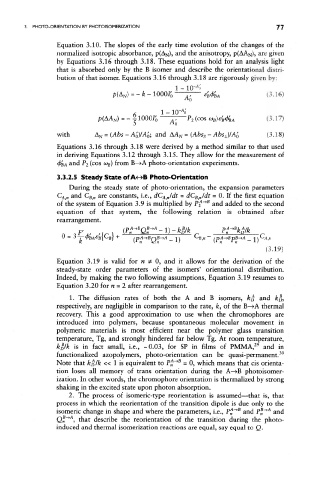
               Equation 3.10. The slopes of the early time evolution of the changes of the
               normalized isotropic absorbance, p(A N), and the anisotropy, p(AA N), are given
               by Equations 3.16 through 3.18. These equations hold for an analysis light
               that is absorbed only by the B isomer and describe the orientational distri-
               bution of that isomer. Equations 3.16 through 3.18 are rigorously given by:
                                                  1 - lO^o
                                p(A N) = -k- 10001^   —,— 4<^                 (3.16)
                                                     A 0
                                                   A
                                      ^       1 - 10- o
                           p(AA N) =- |1000/^ —77—P 2(cos o> B)4<^           (3-17)
                                      5          ^o
               with       A N = (Abs - AO)/AQ; and AA N = (Abs,, - Abs L)IA' Q  (3.18)
               Equations 3.16 through 3.18 were derived by a method similar to that used
               in deriving Equations 3.12 through 3.15. They allow for the measurement of
               <fift A and F 2 ( cos M B) from B—»A photo-orientation experiments.
               3.3.2.5 Steady State of A<-»B Photo-Orientation
                   During the steady state of photo-orientation, the expansion parameters
               C A>n and C B)M are constants, i.e., dC A^ldt - dC$ tJdt = 0. If the first equation
                                                           B
               of the system of Equation 3.9 is multiplied by P^  and added to the second
               equation of that system, the following relation is obtained after
               rearrangement.
                                   I PA-*Br\B-*A  I V  i, B/L   pA->Bi, AIL
                                  — ^ -             D  r       — ^^ r
                                 +    /pA->BQB->A _ |\  ^B,n ~ /pA->BpB-*A _ ^\^A,n
                                                                             (3.19)

               Equation 3.19 is valid for n & 0, and it allows for the derivation of the
               steady-state order parameters of the isomers' orientational distribution.
               Indeed, by making the two following assumptions, Equation 3.19 resumes to
               Equation 3.20 for n = 2 after rearrangement.
                   1. The diffusion rates of both the A and B isomers, h® and kj»
               respectively, are negligible in comparison to the rate, k, of the B-^A thermal
               recovery. This a good approximation to use when the chromophores are
               introduced into polymers, because spontaneous molecular movement in
               polymeric materials is most efficient near the polymer glass transition
               temperature, Tg, and strongly hindered far below Tg. At room temperature,
                                                                         29
               kp/k is in fact small, i.e., ~0.03, for SP in films of PMMA,  and in
               functionalized azopolymers, photo-orientation can be quasi-permanent. 30
                                                  B
               Note that k^lk « I is equivalent to P^  = 0, which means that cis orienta-
               tion loses all memory of trans orientation during the A—>B photoisomer-
               ization. In other words, the chromophore orientation is thermalized by strong
               shaking in the excited state upon photon absorption.
                   2. The process of isomeric-type reorientation is assumed—that is, that
               process in which the reorientation of the transition dipole is due only to the
                                                                     B
                                                                              A
               isomeric change in shape and where the parameters, i.e., P*~*  and P®~*  and
                   A
               Q^~* , that describe the reorientation of the transition during the photo-
               induced and thermal isomerization reactions are equal, say equal to Q.

