


Page 102 - Photoreactive Organic Thin Films
P. 102
3, PHOTO-ORIENTATION BY PHOTOISOMERIZATION                                81


                                   300   350    400    450
                                              Wavelength, X / nm
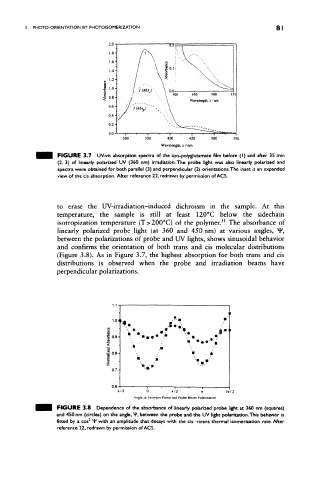
                FIGURE 3.7  UV-vis absorption spectra of the azo-polyglutamate film before (I) and after 35 min
                (2, 3) of linearly polarized UV (360 nm) irradiation. The probe light was also linearly polarized and
                spectra were obtained for both parallel (3) and perpendicular (2) orientations.The inset is an expanded
                view of the cis absorption. After reference 22, redrawn by permission of ACS.


                to erase the UV-irradiation-induced dichroism in the sample. At this
                temperature, the sample is still at least 120°C below the sidechain
                                                                31
                isotropization temperature (T > 200°C) of the polymer.  The absorbance of
                linearly polarized probe light (at 360 and 450 nm) at various angles, *F,
                between the polarizations of probe and UV lights, shows sinusoidal behavior
                and confirms the orientation of both trans and cis molecular distributions
                (Figure 3.8). As in Figure 3.7, the highest absorption for both trans and cis
                distributions is observed when the probe and irradiation beams have
                perpendicular polarizations.


                                   '*.

                                0.9-
                                                      \ *•••••*'*


                                          .*'


                                          0      «/2      it
                                      Angle, i|/, between Pump and Probe Beam Polarization
                FIGURE 3.8 Dependence of the absorbance of linearly polarized probe light at 360 nm (squares)
                and 450 nm (circles) on the angle, V, between the probe and the UV light polarization.This behavior is
                         2
               fitted by a cos  *F with an amplitude that decays with the cis—>trans thermal isomerization rate. After
                reference 22, redrawn by permission of ACS.

