


Page 106 - Photoreactive Organic Thin Films
P. 106
3. PHOTO-ORIENTATION BY PHOTO1SOMERIZATION                                85


                                            (A)


                                                   • PUR-1
                                                   o PUR-2
                                                   • PUR-3
                                                   D PUR-4
                                                     Linear Fit
                                                   I   1    L
                                                       5   10
                                          X'*10 (Einstein, s .L .cm)
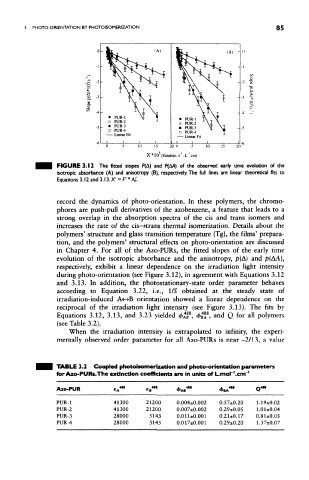
               FIGURE 3.12 The fitted slopes P(A) and P(AA) of the observed early time evolution of the
               isotropic absorbance (A) and anisotrop/ (B), respectively. The full lines are linear theoretical fits to
               Equations 3.12 and 3.13. X' = F * A 0'.


               record the dynamics of photo-orientation. In these polymers, the chromo-
               phores are push-pull derivatives of the azobenzene, a feature that leads to a
               strong overlap in the absorption spectra of the cis and trans isomers and
               increases the rate of the cis-»trans thermal isomerization. Details about the
               polymers' structure and glass transition temperature (Tg), the films' prepara-
               tion, and the polymers' structural effects on photo-orientation are discussed
               in Chapter 4. For all of the Azo-PURs, the fitted slopes of the early time
               evolution of the isotropic absorbance and the anisotropy, p(A) and p(AA),
               respectively, exhibit a linear dependence on the irradiation light intensity
               during photo-orientation (see Figure 3.12), in agreement with Equations 3.12
               and 3.13. In addition, the photostationary-state order parameter behaves
               according to Equation 3.22, i.e., 1/S obtained at the steady state of
               irradiation-induced A<-»B orientation showed a linear dependence on the
               reciprocal of the irradiation light intensity (see Figure 3.13). The fits by
                                                      8
                                                                       r a
               Equations 3.12, 3.13, and 3.23 yielded ^f , <f>BA*->  an d Q fc> ^ polymers
               (see Table 3.2).
                   When the irradiation intensity is extrapolated to infinity, the experi-
               mentally observed order parameter for all Azo-PURs is near -2/13, a value


               TABLE 3.2 Coupled photoisomerization and photo-orientation parameters
               for Azo-PURs.The extinction coefficients are in units of L.moF'.cm"" 1

               Azo-PUR

               PUR-1            41300     21200    0.004*0.002  0.57*0.20  1.19*0.02
               PUR-2            41300     21200    0.007*0.002  0.29*0.05  1.01*0.04
               PUR-3            28000      5143    0.011*0.001  0.21*0.17  0.81*0.05
               PUR-4            28000      5143    0.017*0.001  0.29*0.20  1.37±0.07

