


Page 104 - Photoreactive Organic Thin Films
P. 104
3. PHOTO-ORIENTATION BY PHOTOISOMERIZATION


                                             COS
                                      S A

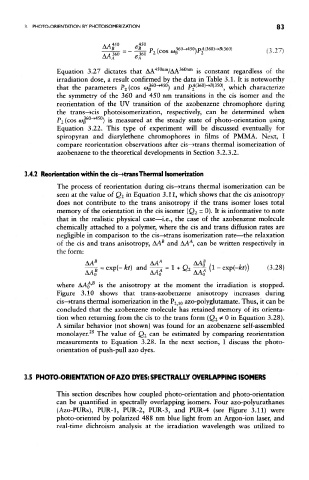
               Equation 3.27 dictates that AA 4SOnm /AA 360nm  is constant regardless of the
               irradiation dose, a result confirmed by the data in Table 3.1. It is noteworthy
                                           60 450       360  B 350
               that the parameters F 2(cos wj ^ ) and p£( >-» < >,  whkh characterize
               the symmetry of the 360 and 450 nm transitions in the cis isomer and the
               reorientation of the UV transition of the azobenzene chromophore during
               the trans— »cis photoisomerization, respectively, can be determined when
                           450
                        60
               P 2 (cos o>B ~* ) is measured at the steady state of photo-orientation using
               Equation 3.22. This type of experiment will be discussed eventually for
               spiropyran and diarylethene chromophores in films of PMMA. Next, I
               compare reorientation observations after cis— Hrans thermal isomerization of
               azobenzene to the theoretical developments in Section 3.2.3.2.


      3.4.2 Reorientation within the cis-)trans Thermal Isomerization
               The process of reorientation during cis— »trans thermal isomerization can be
               seen at the value of Q 2 in Equation 3.11, which shows that the cis anisotropy
               does not contribute to the trans anisotropy if the trans isomer loses total
               memory of the orientation in the cis isomer (Q 2 - 0). It is informative to note
               that in the realistic physical case — i.e., the case of the azobenzene molecule
               chemically attached to a polymer, where the cis and trans diffusion rates are
               negligible in comparison to the cis— »trans isomerization rate — the relaxation
                                              B        A
               of the cis and trans anisotropy, AA  and AA , can be written respectively in
               the form:
                                            .
                                                            (l - exp(-^))    (3.28)
                            = exp(- it) and j , 1  + Q 2
                          B
               where AAo'  is the anisotropy at the moment the irradiation is stopped.
               Figure 3.10 shows that trans-azobenzene anisotropy increases during
               cis-»trans thermal isomerization in the P 2)io azo-polyglutamate. Thus, it can be
               concluded that the azobenzene molecule has retained memory of its orienta-
               tion when returning from the cis to the trans form {Q 2 & 0 in Equation 3.28).
               A similar behavior (not shown) was found for an azobenzene self-assembled
                         28
               monolayer.  The value of Q 2 can be estimated by comparing reorientation
               measurements to Equation 3.28. In the next section, I discuss the photo-
               orientation of push-pull azo dyes.


      3.5 PHOTO-ORIENTATION OF AZO DYES: SPECTRALLY OVERLAPPING ISOMERS

               This section describes how coupled photo-orientation and photo-orientation
               can be quantified in spectrally overlapping isomers. Four azo-polyurathanes
               (Azo-PURs), PUR-1, PUR-2, PUR-3, and PUR-4 (see Figure 3.11) were
               photo-oriented by polarized 488 nm blue light from an Argon-ion laser, and
               real-time dichroism analysis at the irradiation wavelength was utilized to

