


Page 107 - Photoreactive Organic Thin Films
P. 107
ZOUHEIR SEKKAT


                                        DR1/PMMA (2.5 wt.9
                                        - Linear Fit           " PUR-3
                                                               D PUR-4
                                                                Linear Fit


                                                           1.0  2.0  3.0
                                                               5
                                                             10" *1/F'


                              -12
                              -14
                               0.0             0.2     0.3
                                                    5
                                                  1CT *1/F
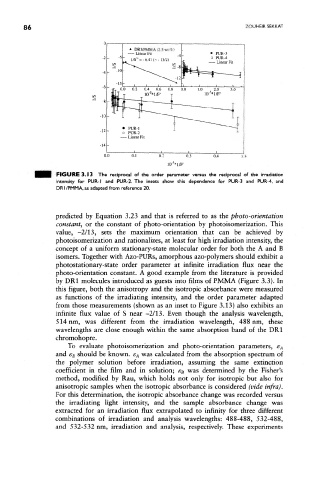
                 FIGURE 3.13 The reciprocal of the order parameter versus the reciprocal of the irradiation
                 intensity for PUR-1 and PUR-2. The insets show this dependence for PUR-3 and PUR-4, and
                 DRI/PMMA,as adapted from reference 20.


                 predicted by Equation 3.23 and that is referred to as the photo-orientation
                 constant, or the constant of photo-orientation by photoisomerization. This
                 value, -2/13, sets the maximum orientation that can be achieved by
                 photoisomerization and rationalizes, at least for high irradiation intensity, the
                 concept of a uniform stationary-state molecular order for both the A and B
                 isomers. Together with Azo-PURs, amorphous azo-polymers should exhibit a
                 photostationary-state order parameter at infinite irradiation flux near the
                 photo-orientation constant. A good example from the literature is provided
                 by DR1 molecules introduced as guests into films of PMMA (Figure 3.3). In
                 this figure, both the anisotropy and the isotropic absorbance were measured
                 as functions of the irradiating intensity, and the order parameter adapted
                 from those measurements (shown as an inset to Figure 3.13) also exhibits an
                 infinite flux value of S near -2/13. Even though the analysis wavelength,
                 514 nm, was different from the irradiation wavelength, 488 nm, these
                 wavelengths are close enough within the same absorption band of the DR1
                 chromohopre.
                    To evaluate photoisomerization and photo-orientation parameters, e A
                 and e B should be known. S A was calculated from the absorption spectrum of
                 the polymer solution before irradiation, assuming the same extinction
                 coefficient in the film and in solution; s% was determined by the Fisher's
                 method, modified by Rau, which holds not only for isotropic but also for
                 anisotropic samples when the isotropic absorbance is considered (vide infra).
                 For this determination, the isotropic absorbance change was recorded versus
                 the irradiating light intensity, and the sample absorbance change was
                 extracted for an irradiation flux extrapolated to infinity for three different
                 combinations of irradiation and analysis wavelengths: 488-488, 532-488,
                 and 532-532 nm, irradiation and analysis, respectively. These experiments

