


Page 96 - Photoreactive Organic Thin Films
P. 96
3, PHOTO-ORIENTATION BY PHOTOISOMERIZATION                                75


                                         40     60    80    tOO
                                         Normalized Irradiation Intensity
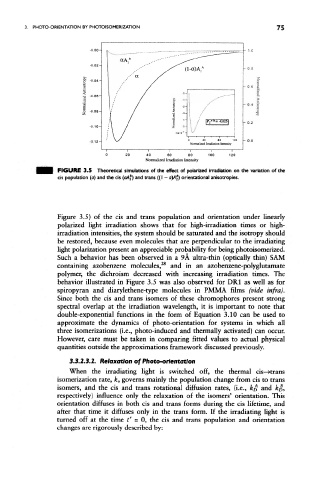
               FIGURE 3.5 Theoretical simulations of the effect of polarized irradiation on the variation of the
               cis population (a) and die cis (oAf) and trans ({I - a)A*) orientational anisotropies.


               Figure 3.5) of the cis and trans population and orientation under linearly
               polarized light irradiation shows that for high-irradiation times or high-
               irradiation intensities, the system should be saturated and the isotropy should
               be restored, because even molecules that are perpendicular to the irradiating
               light polarization present an appreciable probability for being photoisomerized.
               Such a behavior has been observed in a 9A ultra-thin (optically thin) SAM
                                              28
               containing azobenzene molecules,  and in an azobenzene-polyglutamate
               polymer, the dichroism decreased with increasing irradiation times. The
               behavior illustrated in Figure 3.5 was also observed for DR1 as well as for
               spiropyran and diarylethene-type molecules in PMMA films (vide infra).
               Since both the cis and trans isomers of these chromophores present strong
               spectral overlap at the irradiation wavelength, it is important to note that
               double-exponential functions in the form of Equation 3.10 can be used to
               approximate the dynamics of photo-orientation for systems in which all
               three isomerizations (i.e., photo-induced and thermally activated) can occur.
               However, care must be taken in comparing fitted values to actual physical
               quantities outside the approximations framework discussed previously.
                   3.3.2.3.2. Relaxation of Photo-orientation
                   When the irradiating light is switched off, the thermal cis—>trans
               isomerization rate, k, governs mainly the population change from cis to trans
               isomers, and the cis and trans rotational diffusion rates, (i.e., k^ and &p,
               respectively) influence only the relaxation of the isomers' orientation. This
               orientation diffuses in both cis and trans forms during the cis lifetime, and
               after that time it diffuses only in the trans form. If the irradiating light is
               turned off at the time t' = 0, the cis and trans population and orientation
               changes are rigorously described by:

