


Page 92 - Photoreactive Organic Thin Films
P. 92
3. PHOTO-ORIENTATION BY PHOTO1SOMER1ZATION                                7 |

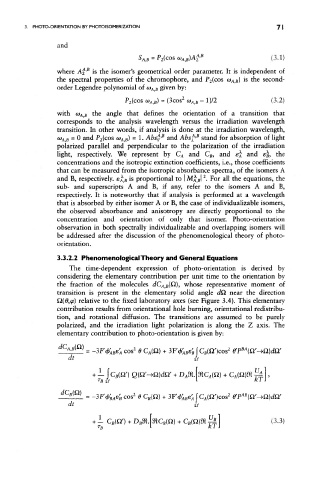
               and
                                                         4 B
                                       S A, B = ? 2(cosa> A)B)A2 '            (3.1)
                        B
               where A 2'  is the isomer's geometrical order parameter. It is independent of
               the spectral properties of the chromophore, and P 2(cos G> AVB) is the second-
               order Legendre polynomial of W A B given by:
                                                    2
                                   F 2(cos fc> A, B) = (3cos  o> A;B - l)/2    (3.2)
               with <w A)B the angle that defines the orientation of a transition that
               corresponds to the analysis wavelength versus the irradiation wavelength
               transition. In other words, if analysis is done at the irradiation wavelength,
               W       an     cos W          B          B
                A,B = 0  d ^2(   A,B) = 1- Absft'  and Abs^  stand for absorption of light
               polarized parallel and perpendicular to the polarization of the irradiation
               light, respectively. We represent by C A and C B, and s\ and eg, the
               concentrations and the isotropic extinction coefficients, i.e., those coefficients
               that can be measured from the isotropic absorbance spectra, of the isomers A
                                                           2
               and B, respectively. £ A)B is proportional to I M A B| . For all the equations, the
               sub- and superscripts A and B, if any, refer to the isomers A and B,
               respectively. It is noteworthy that if analysis is performed at a wavelength
               that is absorbed by either isomer A or B, the case of individualizable isomers,
               the observed absorbance and anisotropy are directly proportional to the
               concentration and orientation of only that isomer. Photo-orientation
               observation in both spectrally individualizable and overlapping isomers will
               be addressed after the discussion of the phenomenological theory of photo-
               orientation.

               3.3.2.2 Phenomenological Theory and General Equations
                   The time-dependent expression of photo-orientation is derived by
               considering the elementary contribution per unit time to the orientation by
               the fraction of the molecules JC A;B(O), whose representative moment of
               transition is present in the elementary solid angle d& near the direction
               Q(0,^>) relative to the fixed laboratory axes (see Figure 3.4). This elementary
               contribution results from orientational hole burning, orientational redistribu-
               tion, and rotational diffusion. The transitions are assumed to be purely
               polarized, and the irradiation light polarization is along the Z axis. The
               elementary contribution to photo-orientation is given by:

                                      2
                        = -3F<£ ABe A cos  $ C A(0) + 3F> ABe B ( C B(a')cos
                  dt                                    Q'


                           T B
                                      2
                        = -3F'<£ BA4 cos  B C B(«) + 3F> ABe A f C A(0')cos
                  dt

                          -f i C B(0') + D B9*.sRC B(«) + C B(&W 2             (33)
                           T B

