


Page 320 - Pipeline Risk Management Manual Ideas, Techniques, and Resources
P. 320
Failure rates 14/297
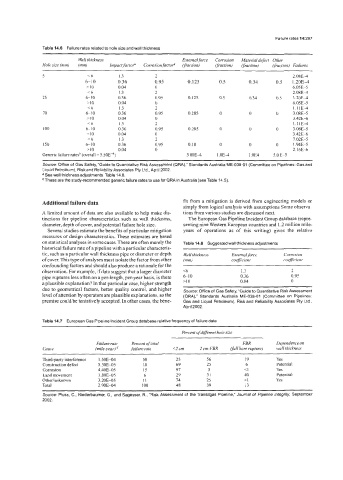
              Table 14.6  Failure rates related to hole size and wall thickness
                                                           ~   ~~~~
                         Wall thickness                 Externalforce   Corrosion   Material defect  Other
              Hole size (mm)   (mm)   Impuct facto?   Corrosion factoP   Ifraction)   Ifraction)   (fraction)   (fraction)  Failures
              5             <6       I .3       2                                         2.08E4
                           6-10      0.36       0.95      0.125     0.5      0.34    0.5   1.20E4
                           >10       0.04       0                                         6.05E-5
                            <6       I .3       2                                         2.08E4
              25           6-10      0.36       0.95      0.125     0.5      0.34    0.5   1.20E4
                           >I0       0.04       0                                         6.05E-5
                            <6       I .3       2                                         I.IIE4
              70           610       0.36       0.95      0.285     0        0       0    3.08E-5
                           >I0       0.04       0                                         3.42E4
                            16       I .3       2                                         l.llE-4
              IO0          6-10      0.36       0.95      0.285     0        0       0    3.088-5
                           >I0       0.04       0                                         3.42E-6
                            <6       1.3        2                                         7.02E-5
              I50          6-10      0.36       0.95      0.18      0        0       0    1.94E-5
                           >I0       0.04       0                                         2.16E-h
              Generic failure ratesb (overall = 5.50E")   3 00E-4   1 .0E4   1.0E4   5.0E-5
              Source: Office  of Gas Safety, "Guide to Quantitative Risk Assessment (QRA)." Standards Australia ME-038.01  (Committee on Pipelines: Gas and
              Liquid Petroleum), Risk and Reliability Associates Pty Ltd.. April 2002.
              a See wall thickness adjustments, Table 14.8.
               These are the study-recommended generic failure rates to use for QRA in Australia (see Table 14.5).


              Additional failure data                    fit from a mitigation  is derived from engineering models or
                                                         simply from logical analysis with assumptions Some observa-
              A limited amount of data are also available to help make dis-   tions from various studies are discussed next.
              tinctions  for  pipeline  characteristics  such  as wall thickness,   The European Gas Pipeline Incident Group database (repre-
              diameter, depth of cover, and potential failure hole size.   senting nine Western European countries and 1.2 million mile-
               Several studies estimate the benefits of particular mitigation   years  of  operations  as  of  this  writing)  gives  the  relative
              measures or design characteristics. These estimates are based
              on statistical analyses in some cases. These are ofienmerely the   Table 14.8  Suggested wall thickness adjustments
              historical failure rate of a pipeline with a particular characteris-
              tic, such as a particular wall thickness pipe or diameter or depth   Wall thickness   External force   Corrosion
              of cover. This type ofanalyses must isolate the factor from other   (mml   coejficient   coefficient
              confounding factors and should also produce a rationale for the
              observation. For example, if data suggest that a larger diameter   <6   1.3   2
              pipe ruptures less often on a per-length, per-year basis, is there   &IO   0.36   0.95
              a plausible explanation? In that particular case, higher strength   >10   0.04   0
              due to geometrical factors, better quality control, and higher   Source: Office  of Gas Safety, "Guide to Quantitative Risk Assessment
              level of attention by operators are plausible explanations, so the   (QRA),"  Standards Australia  ME-038-01  (Committee  on  Pipelines:
              premise could be tentatively accepted. In other cases, the bene-   Gas and Liquid Petroleum), Risk and Reliability Associates Pty Ltd ,
                                                         ADril2002.

              Table 14.7  European Gas Pipeline Incident Group database relative frequency of failure data
                                                        Percent ofdifferent hole size
                              Failure rate   Percent of total              FBR       Dependence on
              Case            (mile-year)-'   failure rufe   <2 cm   2 em-FBR   (jiull bore rupture)   wall thickness
              Third-party interference   I .50E-04   50   25    56         19        Yes
              Construction defect   5.30E-05   18     69        25          6        Potential
              Corrosion        4.40E-05     15        97        3          <I        Yes
              Land movement    1.80E-05      6        29        31         40        Potential
              Otheriunknown    3.20E-05     II        74        25         <I        Yes
              Total            2,90E+4      I00       4s        39         13
              Source:  Pluss, C., Niederbaumer, G., and Sagesser, R.. "Risk Assessment of  the Transitgas Pipeline," Journal of  Pipeline Integrity, September
              2002.

