


Page 154 - Pressure Vessel Design Manual
P. 154
132    Pressure Vessel Design Manual

                                                  PROCEDURE 3-5

                        SEISMIC DESIGN-VESSEL  ON BRACED LEGS [7]


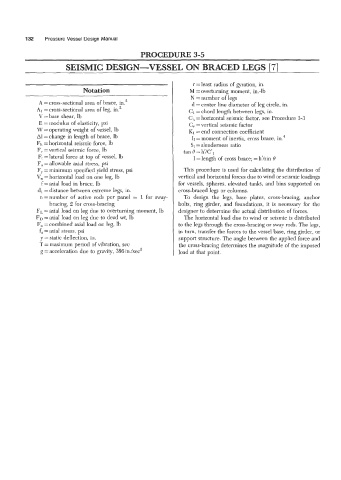
                                                                     r = least radius of gyration, in.
                              Notation                             M =overturning  moment, in.-lb
                                                                    N =number  of legs
              A = cross-sectional area of brace, in.’               d =center  line diameter of leg circle, in.
              AI = cross-sectional area of leg, in.  2             C1= chord length between  legs, in.
              V=base  shear, Ib                                    CI, =horizontal  seismic factor, see Procedure  3-3
              E = modulus of elasticity, psi                       C,  = vertical seismic factor
              W =operating  weight of vessel, lb                   K1= end connection coefficient
              A1 = change in length of brace, lb                    11 = moment of inertia, cross brace, in.4
              Fh =horizontal  seismic force, Ib                     SI = slenderness ratio
              F,  = vertical seismic force, Ib                   tan 8 = h’C1
              F, =lateral  force at top of vessel, lb                1 = length of cross brace; = h’/sin  8
              Fa = allowable axial stress, psi
              Fy = minimum specified yield stress, psi           This procedure  is used  for calculating the  distribution  of
              V,  =horizontal  load on one leg, lb             vertical and horizontal forces due to wind or seismic loadings
               f = axial load in brace, lb                     for vessels, spheres, elevated tanks,  and bins  supported on
              dl =distance  between  extreme legs, in.         cross-braced  legs or columns.
               n =number  of  active  rods  per  pane1  = 1  for  sway-   To  design  the  legs,  base  plates,  cross-bracing,  anchor
                  bracing, 2 for cross-bracing                 bolts,  ring  girder,  and  foundations,  it  is  necessary  for  the
              FL = axial load on leg due to overturning moment, lb   designer to determine the actual distribution  of forces.
             FD = axial load on leg due to dead wt,  Ib          The horizontal load due to wind or seismic is distributed
              F,  = combined axial load on leg, lb             to the legs through the cross-bracing or sway rods. The legs,
               fa =axial  stress, psi                          in turn, transfer the forces to the vessel base, ring girder, or
               y = static deflection, in.                       support structure. The angle between the applied force and
               T = maximum period of vibration, sec            the cross-bracing determines the magnitude of the imposed
               g = acceleration  due to gravity, 386 in./sec2   load at that point.

