


Page 270 - Radar Technology Encyclopedia
P. 270
magnetron, inverted-coaxial                                                  magnetron, spin-tuned  260


           small, so the usual construction would leave inadequate room  quency tuning and the use of frequencies over a wide band.
           for the anode and cathode structure. Sometimes this structure  However, they do not provide coherence from pulse to pulse,
           is also called an inverted magnetron. SAL            have low frequency stability and a comparatively high power
           Ref.: Skolnik (1990), p. 4.7.                        of parasitic radiation.
                                                                    This device is also called a multicavity, multicircuit, or
           mechanically-tuned magnetron (see tunable magnetron).
                                                                multisectional magnetron. IAM
           A multipactor-tuned magnetron uses the effect of a multi-  Ref.: Gilmour (1986), p. 352; Leonov (1988), pp. 45, 46; Andrushko (1981),
           pactor discharge to vary the frequency of an auxiliary coupled  p. 81.
           resonator, which in turn changes the magnetron operation fre-
                                                                A  pulsed magnetron is one operating in a pulsed mode.
           quency. Each auxiliary cavity is coupled to a given anode and
                                                                Pulsed modulation typically is obtained by applying a nega-
           can be turned on or off independently, so in general 2n com-
                                                                tive rectangular voltage pulse to the cathode with the anode at
           binations of frequencies may be selected, where n is a number
                                                                ground potential. The devices have been developed covering
           of cavities. SAL
                                                                frequency ranges from a few hundred megahertz to 100 GHz,
           Ref.: Ewell (1981), p. 28.
                                                                the  peak power  up to several  megawatts, the  efficiency  is
           A multiresonator magnetron has an anode unit in the form  about 30 to 40%. High-power pulsed magnetrons are prima-
           of connected three-dimensional  resonators. In the central  rily used in simple radar transmitters. Low-power pulsed
           opening of the anode unit is a cathode, and in one of the reso-  magnetrons find applications in radar beacons.
           nators is a connector loop by which the RF output is transmit-  Some commercially available high-power pulsed magne-
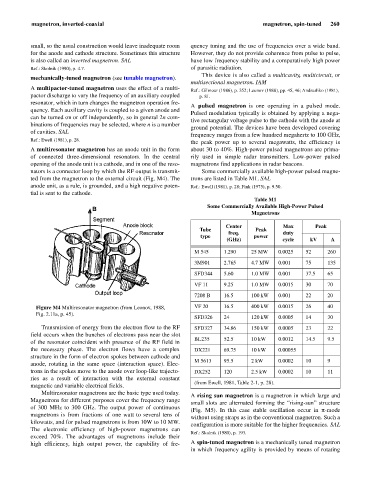
           ted from the magnetron to the external circuit (Fig. M4). The  trons are listed in Table M1. SAL
           anode unit, as a rule, is grounded, and a high negative poten-  Ref.: Ewell (1981), p. 28; Fink (1975), p. 9.50.
           tial is sent to the cathode.
                                                                                     Table M1
                                                                     Some Commercially Available High-Power Pulsed
                                                                                    Magnetrons
                                                                            Center            Max        Peak
                                                                   Tube     freq.    Peak     duty
                                                                   type              power
                                                                            (GHz)             cycle     kV     A

                                                                 M 545     1.290    25 MW    0.0025   52     260
                                                                 3M901     2.765    4.7 MW   0.001    75     135
                                                                 SFD344    5.60     1.0 MW   0.001    37.5   65
                                                                 VF 11     9.25     1.0 MW   0.0015   30     70
                                                                 7208 B    16.5     100 kW   0.001    22     20

             Figure M4 Multiresonator magnetron (from Leonov, 1988,   VF 20  16.5   400 kW   0.0015   26     40
             Fig. 2.11a, p. 45).
                                                                 SFD326    24       120 kW   0.0005   14     30
               Transmission of energy from the electron flow to the RF  SFD327  34.86  150 kW  0.0005  23    22
           field occurs when the bunches of electrons pass near the slot
                                                                 BL235     52.5     10 kW    0.0012   14.5   9.5
           of the resonator coincident with presence of the RF field in
           the necessary phase. The electron  flows have a complex  DX221  69.75    10 kW    0.00055
           structure in the form of electron spokes between cathode and
                                                                 M 5613    95.5     2 kW     0.0002   10     9
           anode, rotating  in the  same space (interaction space). Elec-
           trons in the spokes move to the anode over loop-like trajecto-  DX252  120  2.5 kW  0.0002  10    11
           ries as a result of  interaction with  the  external constant
                                                                 (from Ewell, 1981, Table 2-1, p. 28).
           magnetic and variable electrical fields.
               Multiresonator magnetrons are the basic type used today.
                                                                A rising sun magnetron is a magnetron in which large and
           Magnetrons for different purposes cover the frequency range
                                                                small slots are alternated forming the “rising-sun” structure
           of 300 MHz to 300 GHz. The output power of continuous
                                                                (Fig. M5). In this  case  stable oscillation occur  in  p-mode
           magnetrons is from fractions of one watt to several  tens of
                                                                without using straps as in the conventional magnetron. Such a
           kilowatts, and for pulsed magnetrons is from 10W to 10 MW.
                                                                configuration is more suitable for the higher frequencies. SAL
           The  electronic efficiency  of high-power magnetrons  can
                                                                Ref.: Skolnik (1980), p. 193.
           exceed 70%. The advantages of magnetrons include their
           high efficiency, high output power, the capability of fre-  A spin-tuned magnetron is a mechanically tuned magnetron
                                                                in which frequency agility is provided by means of rotating

