


Page 236 - Robot Builders Source Book - Gordon McComb
P. 236
224                          Transporting Devices

        inclination/?. Armature 3 of the magnet is fastened to the tray, while magnet 4 is mounted
        on the base of the device. Now we consider the operation of one spring. Its lower end
        is fastened to the base at point O and its upper end A is connected to the tray. When
        the coil of electromagnet 4 is energized, the armature 3 is pulled towards the magnet.
        Tray 1 moves together with the armature, and the springs deflect by a corresponding
        angle. As a result, the initial inclination angle /? increases by A/? while point A moves to
        point A! along an arc with radius R. Thus every point of the tray is displaced horizon-
        tally by distance L and vertically by length h, and the whole tray passes from position
        I-I to position II-II. When the voltage feeding the coil of the electromagnet is switched
        off, the elastic forces of springs 2 return the tray to its previous position, thus complet-
        ing one cycle of the device's operation. With the standard alternating current network,
        one can obtain either 100 cycles per second or 50 cycles per second (with a rectifier).
           Let us consider the behavior of a body possessing mass m and located on the tray.
        This body exerts a downward pressure on the tray by its weight, which obviously equals
        mg. A frictional force P F appears in the horizontal direction. This force depends on the
        frictional coefficient n (characteristic of the tray and body materials) and on the ver-
        tical force N that the body exerts on the tray during the tray's motion. During this
        motion, varying horizontal and vertical acceleration components appear. The vertical


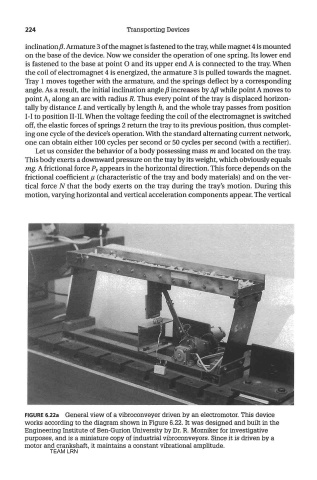
        FIGURE 6.22a General view of a vibroconveyer driven by an electromotor. This device
        works according to the diagram shown in Figure 6.22. It was designed and built in the
        Engineering Institute of Ben-Gurion University by Dr. R. Mozniker for investigative
        purposes, and is a miniature copy of industrial vibroconveyors. Since it is driven by a
        motor and crankshaft, it maintains a constant vibrational amplitude.
               TEAM LRN

