


Page 239 - Robot Builders Source Book - Gordon McComb
P. 239
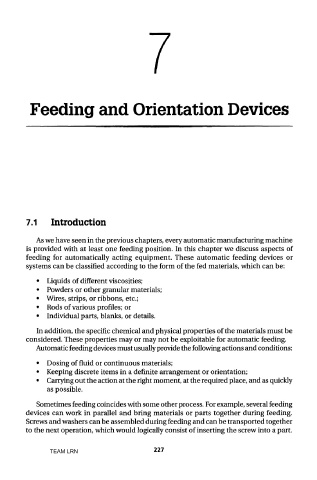
7


          Feeding and Orientation Devices


         7.1    Introduction

            As we have seen in the previous chapters, every automatic manufacturing machine
         is provided with at least one feeding position. In this chapter we discuss aspects of
         feeding for automatically acting equipment. These automatic feeding devices or
         systems can be classified according to the form of the fed materials, which can be:

               Liquids of different viscosities;
               Powders or other granular materials;
               Wires, strips, or ribbons, etc.;
               Rods of various profiles; or
               Individual parts, blanks, or details.

            In addition, the specific chemical and physical properties of the materials must be
         considered. These properties may or may not be exploitable for automatic feeding.
            Automatic feeding devices must usually provide the following actions and conditions:
            • Dosing of fluid or continuous materials;
            • Keeping discrete items in a definite arrangement or orientation;
            • Carrying out the action at the right moment, at the required place, and as quickly
               as possible.

            Sometimes feeding coincides with some other process. For example, several feeding
         devices can work in parallel and bring materials or parts together during feeding.
         Screws and washers can be assembled during feeding and can be transported together
         to the next operation, which would logically consist of inserting the screw into a part.


               TEAM LRN                      227

