


Page 141 - Statistics for Dummies
P. 141
Chapter 7: Going by the Numbers: Graphing Numerical Data
                                                    rather than the crime rate (crimes per capita) — because the population size
                                                    of a city changes over time, crime rate is the appropriate measure. Make sure
                                                    you understand what numbers are being graphed and examine them for fair-
                                                    ness and appropriateness.
                                                    Watching the scale and start/end points
                                                    The scale on the vertical axis can make a big difference in the way the time
                                                    chart looks. Refer to Figure 7-12 to see my original time chart of the ages for
                                                    the Best Actress Academy Award winners from 1928–2009 in increments of
                                                    10 years. You see a fair amount of variability, as discussed previously.
                                                    In Figure 7-12, the starting and ending points on the vertical axis are 0 to 100,
                                                    which creates a little bit of extra white space on the top and bottom of the
                                                    picture. I could have used 10 and 90 as my start/end points, but this graph
                                                    looks reasonable.
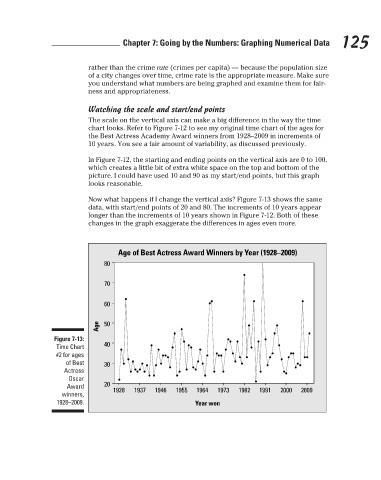
                                                    Now what happens if I change the vertical axis? Figure 7-13 shows the same
                                                    data, with start/end points of 20 and 80. The increments of 10 years appear   125
                                                    longer than the increments of 10 years shown in Figure 7-12. Both of these
                                                    changes in the graph exaggerate the differences in ages even more.
                                                            Age of Best Actress Award Winners by Year (1928–2009)
                                                        80
                                                        70
                                                        60
                                                      Age  50
                                          Figure 7-13:
                                                        40
                                           Time Chart
                                           #2 for ages
                                             of Best    30
                                             Actress
                                              Oscar
                                                        20
                                              Award
                                                           1928  1937  1946  1955  1964  1973  1982  1991  2000  2009
                                            winners,
                                           1928–2009.                            Year won


                                                                                                                           3/25/11   8:16 PM
                             12_9780470911082-ch07.indd   125                                                              3/25/11   8:16 PM
                             12_9780470911082-ch07.indd   125

