


Page 340 - Statistics for Environmental Engineers
P. 340
L1592_frame_C39  Page 349  Tuesday, December 18, 2001  3:22 PM


                                          30
                                              R 2  =  0.77        R 2  =  0.12
                                                           •  •
                                                          • • • •
                                                      • • • • •  •  •     • •
                                                                          •
                                                      •
                                         y  20    • •  • •  • • • • • • •  • •  • •
                                                       •
                                                                         • •
                                                    • •
                                                  •  • •  •  •           •  •  •
                                               • •  • •  •               •
                                                  •
                                               • •  • •
                                               • •
                                               • •
                                               • •
                                          10
                                          30                  •
                                              R 2  =  0.88        R 2  =  0.93
                                                             •                   •
                                                             • •                 • •
                                                      • •    •                   •
                                         y  20        • •
                                                      •
                                               •                   •
                                               •                   •
                                               •                   •
                                               •                   •
                                          10
                                               10     15    20     10    15     20
                                                      x                   x
                                                                        2                            2
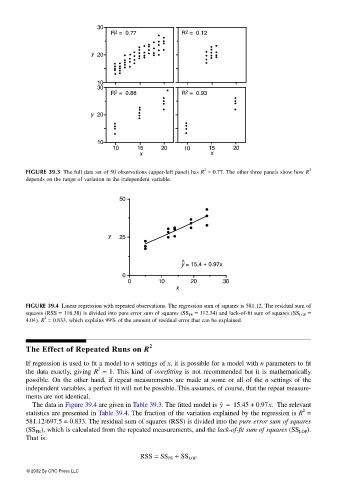
                       FIGURE 39.3  The full data set of 50 observations (upper-left panel) has R  = 0.77. The other three panels show how R
                       depends on the range of variation in the independent variable.
                                                 50
                                             y   25


                                                                  ^
                                                                  y = 15.4 + 0.97x
                                                 0
                                                   0       10       20       30
                                                                x


                       FIGURE 39.4  Linear regression with repeated observations. The regression sum of squares is 581.12. The residual sum of
                       squares (RSS = 116.38) is divided into pure error sum of squares (SS PE  = 112.34) and lack-of-fit sum of squares (SS LOF  =
                            2
                       4.04). R  = 0.833, which explains 99% of the amount of residual error that can be explained.


                       The Effect of Repeated Runs on R  2

                       If regression is used to fit a model to n settings of x, it is possible for a model with n parameters to fit
                                           2
                       the data exactly, giving R = 1. This kind of overfitting is not recommended but it is mathematically
                       possible. On the other hand, if repeat measurements are made at some or all of the n settings of the
                       independent variables, a perfect fit will not be possible. This assumes, of course, that the repeat measure-
                       ments are not identical.
                        The data in Figure 39.4 are given in Table 39.3. The fitted model is y ˆ =  15.45 +  0.97x.  The relevant
                       statistics are presented in Table 39.4. The fraction of the variation explained by the regression is R  =
                                                                                                    2
                       581.12/697.5 = 0.833. The residual sum of squares (RSS) is divided into the pure error sum of squares
                       (SS PE ), which is calculated from the repeated measurements, and the lack-of-fit sum of squares (SS LOF ).
                       That is:


                                                      RSS = SS PE  + SS LOF
                       © 2002 By CRC Press LLC

