


Page 341 - Statistics for Environmental Engineers
P. 341
L1592_frame_C39  Page 350  Tuesday, December 18, 2001  3:22 PM


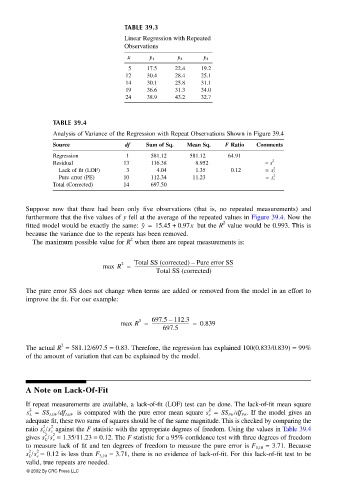
                                                  TABLE 39.3
                                                  Linear Regression with Repeated
                                                  Observations
                                                   x     y 1     y 2    y 3
                                                   5    17.5    22.4   19.2
                                                  12    30.4    28.4   25.1
                                                  14    30.1    25.8   31.1
                                                  19    36.6    31.3   34.0
                                                  24    38.9    43.2   32.7


                              TABLE 39.4
                              Analysis of Variance of the Regression with Repeat Observations Shown in Figure 39.4
                              Source              df    Sum of Sq.  Mean Sq.  F Ratio  Comments
                              Regression           1     581.12     581.12     64.91
                              Residual            13     116.38       8.952              = s 2
                                Lack of fit (LOF)   3       4.04       1.35      0.12     =  s L 2
                                Pure error (PE)   10     112.34      11.23               =  s e 2
                              Total (Corrected)   14     697.50


                       Suppose now that there had been only  five observations (that is, no repeated measurements) and
                       furthermore that the five values of y fell at the average of the repeated values in Figure 39.4. Now the
                       fitted model would be exactly the same: y ˆ =  15.45 +  0.97x   but the R  value would be 0.993. This is
                                                                             2
                       because the variance due to the repeats has been removed.
                                                    2
                        The maximum possible value for R  when there are repeat measurements is:

                                                                     –
                                            max R =  Total SS (corrected) Pure error SS
                                                 2
                                                     ---------------------------------------------------------------------------------------
                                                           Total SS (corrected)
                       The pure error SS does not change when terms are added or removed from the model in an effort to
                       improve the fit. For our example:


                                                              –
                                                          --------------------------------- =
                                                 max R =  697.5 112.3  0.839
                                                      2
                                                             697.5
                                2
                       The actual R  = 581.12/697.5 = 0.83. Therefore, the regression has explained 100(0.833/0.839) = 99%
                       of the amount of variation that can be explained by the model.


                       A Note on Lack-Of-Fit

                       If repeat measurements are available, a lack-of-fit (LOF) test can be done. The lack-of-fit mean square
                       s L =  SS LOF /df LOF   is compared with the pure error mean square s e =  SS PE /df PE .  If the model gives an
                                                                         2
                        2
                       adequate fit, these two sums of squares should be of the same magnitude. This is checked by comparing the
                           2  2
                       ratio s L /s e  against the F statistic with the appropriate degrees of freedom. Using the values in Table 39.4
                            2  2
                       gives s L /s e  = 1.35/11.23 = 0.12. The F statistic for a 95% confidence test with three degrees of freedom
                       to measure lack of fit and ten degrees of freedom to measure the pure error is F 3,10  = 3.71. Because
                       2  2
                       s L /s e  = 0.12 is less than F 3,10  = 3.71, there is no evidence of lack-of-fit. For this lack-of-fit test to be
                       valid, true repeats are needed.
                       © 2002 By CRC Press LLC

