


Page 282 - The Engineering Guide to LEED-New Construction Sustainable Construction for Engineers
P. 282
LEED Indoor Envir onmental Quality     245


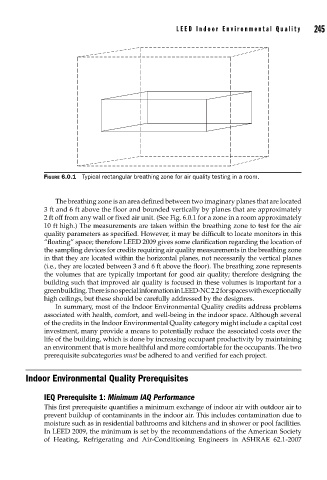
             FIGURE 6.0.1  Typical rectangular breathing zone for air quality testing in a room.


                 The breathing zone is an area defined between two imaginary planes that are located
             3 ft and 6 ft above the floor and bounded vertically by planes that are approximately
             2 ft off from any wall or fixed air unit. (See Fig. 6.0.1 for a zone in a room approximately
             10 ft high.) The measurements are taken within the breathing zone to test for the air
             quality parameters as specified. However, it may be difficult to locate monitors in this
             “floating” space; therefore LEED 2009 gives some clarification regarding the location of
             the sampling devices for credits requiring air quality measurements in the breathing zone
             in that they are located within the horizontal planes, not necessarily the vertical planes
             (i.e., they are located between 3 and 6 ft above the floor). The breathing zone represents
             the volumes that are typically important for good air quality; therefore designing the
             building such that improved air quality is focused in these volumes is important for a
             green building. There is no special information in LEED-NC 2.2 for spaces with exceptionally
             high ceilings, but these should be carefully addressed by the designers.
                 In summary, most of the Indoor Environmental Quality credits address problems
             associated with health, comfort, and well-being in the indoor space. Although several
             of the credits in the Indoor Environmental Quality category might include a capital cost
             investment, many provide a means to potentially reduce the associated costs over the
             life of the building, which is done by increasing occupant productivity by maintaining
             an environment that is more healthful and more comfortable for the occupants. The two
             prerequisite subcategories must be adhered to and verified for each project.


        Indoor Environmental Quality Prerequisites

             IEQ Prerequisite 1: Minimum IAQ Performance
             This first prerequisite quantifies a minimum exchange of indoor air with outdoor air to
             prevent buildup of contaminants in the indoor air. This includes contamination due to
             moisture such as in residential bathrooms and kitchens and in shower or pool facilities.
             In LEED 2009, the minimum is set by the recommendations of the American Society
             of Heating, Refrigerating and  Air-Conditioning Engineers in  ASHRAE 62.1-2007

