


Page 652 - The Mechatronics Handbook
P. 652
0066_Frame_C20.fm Page 122 Wednesday, January 9, 2002 1:47 PM
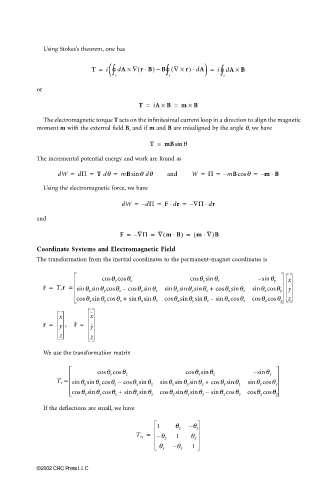
Using Stokes’s theorem, one has
∫
∫
⋅
(
T = i ∫ s ° dA × ∇ rB) B ( ∇ × r) dA = idA × B
⋅
s °
s °
–
or
T = iA × B = m × B
The electromagnetic torque T acts on the infinitesimal current loop in a direction to align the magnetic
moment m with the external field B, and if m and B are misaligned by the angle θ, we have
T = mBsin q
The incremental potential energy and work are found as
⋅
dW = dΠ = T dq = mBsin q dq and W = Π = – mBcos q = – mB
Using the electromagnetic force, we have
⋅
dW = – dΠ = F dr = – ∇Π dr
⋅
and
⋅
⋅
(
F = – ∇Π = ∇ mB) = ( m ∇)B
Coordinate Systems and Electromagnetic Field
The transformation from the inertial coordinates to the permanent-magnet coordinates is
cos q y cos q z cos q y sin q z – sin q y x
r = T r r = sin q x sin q y cos q z – cos q x sin q z sin q x sin q y sin q z + cos q x sin q z sin q x cos q y y
cos q x sin q y cos q z + sin q x sin q z cos q x sin q y sin q z – sin q x cos q z cos q x cos q y z
x x
r = y , r = y
z z
We use the transformation matrix
cos q y cos q z cos q y sin q z – sin q y
T r = sin q x sin q y cos q z – cos q x sin q z sin q x sin q y sin q z + cos q x sin q z sin q x cos q y
cos q x sin q y cos q z + sin q x sin q z cos q x sin q y sin q z – sin q x cos q z cos q x cos q y
If the deflections are small, we have
1 q z −q y
T rs =
−q z 1 q x
– 1
q y q x
©2002 CRC Press LLC

