


Page 934 - The Mechatronics Handbook
P. 934
0066_Frame_C30  Page 45  Thursday, January 10, 2002  4:45 PM


                       State Feedback Loop Shaping
                       If one selects


                                                        B 2 =  B                               (30.246)


                                                        C 1 =  M                               (30.247)
                                                              0 n ×  n
                                                               u


                                                               0 n ×  n
                                                       D 12 =   y  u                           (30.248)
                                                               rI n ×  n
                                                                  u  u
                                                        R =  rI n ×                            (30.249)
                                                               u  n u

                            T
                       then  D 12 C 1 =  0   and we have


                                                          G c =  1  T                          (30.250)
                                                              ---B 2 X
                                                              r

                       where X ≥ 0 is the unique (at least) positive semi-definite solution of the CARE:


                                                                    1
                                                A X + XA +  M MXB---B X =  0                   (30.251)
                                                            T
                                                 T
                                                                      T
                                                               –
                                                                   r
                       The following LQFDE may be derived from the CARE:
                                                                               1
                                                                   1
                                               H
                                                [
                                                       (
                                    [ I + G LQ jw(  )] I + G LQ jw)] =  I +  -------G OL jw(  )  H  -------G OL jw(  )  (30.252)
                                                                   r            r
                       where

                                                                    –
                                                             (
                                                     G OL =  MsI A) B                          (30.253)
                                                                    1
                                                                –
                                                              (
                                                      G LQ =  G c sI A) B                      (30.254)
                                                                    –
                                                                     1
                                                                –
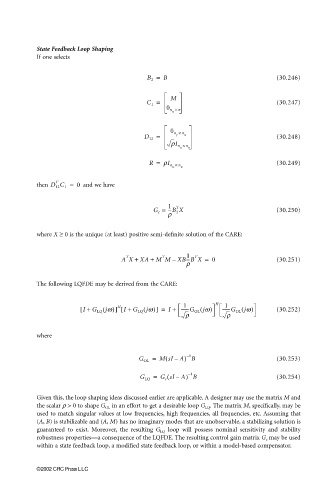
                       Given this, the loop shaping ideas discussed earlier are applicable. A designer may use the matrix M and
                       the scalar ρ > 0 to shape G OL  in an effort to get a desirable loop G LQ . The matrix M, specifically, may be
                       used to match singular values at low frequencies, high frequencies, all frequencies, etc. Assuming that
                       (A, B) is stabilizable and (A, M) has no imaginary modes that are unobservable, a stabilizing solution is
                       guaranteed to exist. Moreover, the resulting  G LQ  loop will possess nominal sensitivity and stability
                       robustness properties—a consequence of the LQFDE. The resulting control gain matrix G c  may be used
                       within a state feedback loop, a modified state feedback loop, or within a model-based compensator.


                       ©2002 CRC Press LLC

