


Page 317 - Thermal Hydraulics Aspects of Liquid Metal Cooled Nuclear Reactors
P. 317
Turbulent heat transport                                          287

                      υ t
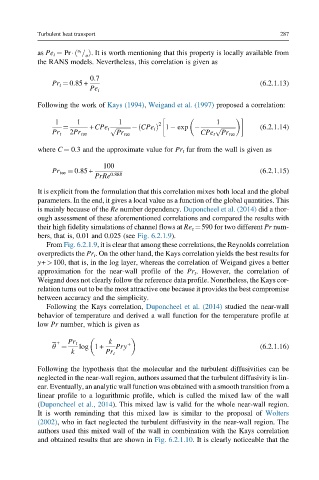
           as Pe t ¼ Pr ð  = Þ. It is worth mentioning that this property is locally available from
                        υ
           the RANS models. Nevertheless, this correlation is given as
                         0:7
               Pr t ¼ 0:85 +                                           (6.2.1.13)
                         Pe t
           Following the work of Kays (1994), Weigand et al. (1997) proposed a correlation:


                1     1          1          2              1
                                      ð
                               p
                  ¼      + CPe t ffiffiffiffiffiffiffiffiffiffi  CPe t Þ 1  exp    p ffiffiffiffiffiffiffiffiffiffi  (6.2.1.14)
               Pr t  2Pr t∞     Pr t∞                  CPe t Pr t∞
           where C¼ 0.3 and the approximate value for Pr t far from the wall is given as
                             100
               Pr t∞ ¼ 0:85 +                                          (6.2.1.15)
                           PrRe 0:888
           It is explicit from the formulation that this correlation mixes both local and the global
           parameters. In the end, it gives a local value as a function of the global quantities. This
           is mainly because of the Re number dependency. Duponcheel et al. (2014) did a thor-
           ough assessment of these aforementioned correlations and compared the results with
           their high fidelity simulations of channel flows at Re τ ¼590 for two different Pr num-
           bers, that is, 0.01 and 0.025 (see Fig. 6.2.1.9).
              From Fig. 6.2.1.9, it is clear that among these correlations, the Reynolds correlation
           overpredicts the Pr t . On the other hand, the Kays correlation yields the best results for
           y+>100, that is, in the log layer, whereas the correlation of Weigand gives a better
           approximation for the near-wall profile of the Pr t . However, the correlation of
           Weigand does not clearly follow the reference data profile. Nonetheless, the Kays cor-
           relation turns out to be the most attractive one because it provides the best compromise
           between accuracy and the simplicity.
              Following the Kays correlation, Duponcheel et al. (2014) studied the near-wall
           behavior of temperature and derived a wall function for the temperature profile at
           low Pr number, which is given as


                +  Pr t       k     +
               θ ¼    log 1 +   Pry                                    (6.2.1.16)
                    k         Pr t
           Following the hypothesis that the molecular and the turbulent diffusivities can be
           neglected in the near-wall region, authors assumed that the turbulent diffusivity is lin-
           ear. Eventually, an analytic wall function was obtained with a smooth transition from a
           linear profile to a logarithmic profile, which is called the mixed law of the wall
           (Duponcheel et al., 2014). This mixed law is valid for the whole near-wall region.
           It is worth reminding that this mixed law is similar to the proposal of Wolters
           (2002), who in fact neglected the turbulent diffusivity in the near-wall region. The
           authors used this mixed wall of the wall in combination with the Kays correlation
           and obtained results that are shown in Fig. 6.2.1.10. It is clearly noticeable that the

