


Page 482 - Bird R.B. Transport phenomena
P. 482
462  Chapter 15  Macroscopic Balances for Nonisothermal Systems

                           in  which / is  the local  friction  factor, and  R h  is  the local value  of  the mean hydraulic  ra-
                           dius.  In most  applications we  omit the dW term, since work  is  usually  done at  isolated
                           points along the flow path. The term dW would be needed in tubes with extensible walls,
                           magnetically  driven flows, or systems  with transport by rotating  screws.


      The  d°Form of the Total Energy Balance
                           If we write  Eq. 15.1-3 in differential  form, we have  (with flat velocity  profiles)
                                                       2
                                                    d(\v )  + gdh  + dH = dQ  + dW              (15.4-3)
                           Then using  Eq. 9.8-7  for dH and Eq. 14.1-8 for  dQ we  get

                                         vdv  + gdh  + C dT  +\v-  г ( | Ю  \dp =  Ul0C ^ T  dl  + dW  (15.4-4)
                                                    p
                           in  which  U,  is  the  local  overall  heat  transfer  coefficient,  Z  is  the corresponding  local
                                      oc
                           conduit  perimeter, and  AT is  the local temperature difference  between  the  fluids  inside
                           and  outside of the conduit.
                               The  examples  that follow illustrate applications of Eqs. 15.4-2 and  15.4-4.


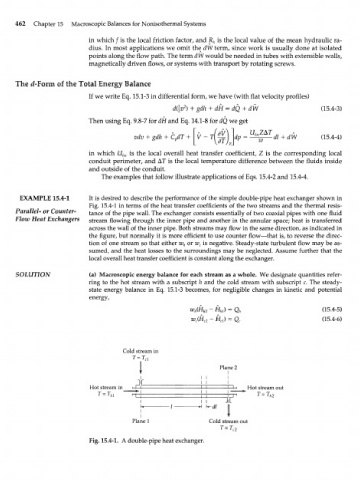
       EXAMPLE   15.4-1    It is desired  to describe the performance  of  the simple double-pipe heat exchanger  shown  in
                           Fig.  15.4-1  in terms  of  the heat transfer  coefficients  of  the two  streams and the thermal resis-
      Parallel- or Counter-  tance  of  the pipe wall. The exchanger  consists  essentially  of  two  coaxial pipes with  one fluid
      Flow Heat  Exchangers  stream flowing through the inner pipe and another in the annular space; heat is  transferred
                           across the wall  of the inner pipe. Both streams may flow in the same direction, as indicated in
                           the  figure,  but normally it is more efficient  to use counter flow—that is, to reverse  the direc-
                           tion  of  one stream  so that either w h  or w c  is  negative.  Steady-state turbulent flow may be as-
                           sumed, and  the heat losses  to the surroundings  may  be  neglected.  Assume  further  that the
                           local overall heat transfer  coefficient  is constant along the exchanger.

      SOLUTION             (a)  Macroscopic energy  balance  for  each stream as a whole.  We  designate  quantities  refer-
                           ring  to the hot stream  with  a  subscript  h and  the cold  stream  with  subscript  с  The  steady-
                           state  energy  balance  in  Eq.  15.1-3  becomes,  for  negligible  changes  in  kinetic  and potential
                           energy,
                                                         w m 2  -H )  = Q                       (15.4-5)
                                                          h  h   h]    H
                                                         w (H  -  H )  =  Q                     (15.4-6)
                                                          c  c2   cl   c


                                     Cold stream in
                                        T                         Plane 2


                            Hot stream in  Jt—                            Hot stream out


                                                              I— dl  I

                                        Plane 1                Cold stream out
                                                                  T  =  T c2
                           Fig.  15.4-1.  A double-pipe heat exchanger.

