


Page 484 - Bird R.B. Transport phenomena
P. 484
464   Chapter 15  Macroscopic Balances  for Nonisothermal Systems

                                           Cooler  |                I  Cooler
                           Natural                                                 Natural
                             gas                                                    gas
                                       Compressor  j  /           Compressor
                                                 I                  I
                                                 I                  I
                                               Plane 1            Plane 2  Plane 3
                                                / = 0                   / = 10  miles
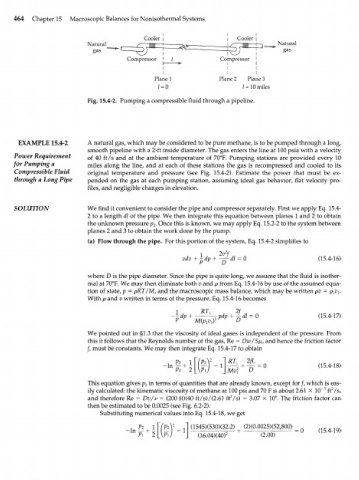
                           Fig. 15.4-2.  Pumping a compressible  fluid  through a pipeline.


       EXAMPLE  15.4-2     A natural gas, which  may be considered  to be pure methane, is to be pumped through a long,
                           smooth pipeline with a  2-ft  inside diameter. The gas  enters the line at  100 psia  with  a  velocity
     Power Requirement     of  40  ft/s  and  at  the ambient temperature  of  70°F.  Pumping  stations  are  provided  every  10
     for  Pumping a        miles  along  the line, and  at  each  of  these  stations  the gas  is  recompressed  and  cooled  to its
     Compressible Fluid    original  temperature  and  pressure  (see  Fig.  15.4-2).  Estimate  the  power  that  must  be  ex-
     through a Long Pipe   pended  on the gas  at  each pumping  station, assuming  ideal  gas  behavior,  flat  velocity  pro-
                           files, and negligible  changes in elevation.


     SOLUTION              We  find  it convenient to consider the pipe and compressor separately.  First we apply  Eq. 15.4-
                           2 to a length dl  of  the pipe. We  then integrate this equation between  planes  1 and 2 to obtain
                           the unknown pressure p . Once this is known, we  may apply  Eq. 15.2-2 to the system  between
                                              2
                           planes 2 and 3 to obtain the work  done by  the pump.
                           (a)  Flow through the pipe.  For this portion of the system,  Eq. 15.4-2 simplifies  to
                                                            1
                                                       vdv  + ^                                (15.4-16)

                           where  D is the pipe diameter. Since the pipe is quite long, we  assume  that the fluid  is isother-
                           mal  at 70°F. We may then eliminate both v and p from  Eq. 15.4-16 by use  of the assumed  equa-
                           tion  of state, p  = pRT/M, and the macroscopic mass balance, which  may be written pv  = p^v^.
                           With  p and v written in terms of the pressure, Eq. 15.4-16 becomes

                                                                                               (15.4-17)

                           We  pointed out in  §1.3 that the viscosity  of  ideal  gases  is independent  of  the pressure. From
                           this it follows that the Reynolds number of the gas,  Re = Dw/Sfi,  and hence the friction  factor
                           /, must be constants. We  may then integrate Eq. 15.4-17 to obtain

                                                                          2fL
                                                                                               (15.4-18)

                           This equation gives p  in terms  of quantities that are already  known, except  for /, which  is eas-
                                            2
                                                                                                   2
                           ily calculated: the kinematic viscosity  of methane at  100 psi and  70 F is about 2.61  X  10  n  ft /s,
                                                                                  6
                                                                     2
                           and  therefore  Re = Dv/v  =  (200  ft)(40  ft/s)/(2.61  ft /s)  = 3.07  X  10 . The friction  factor  can
                           then be estimated  to be 0.0025 (see Fig. 6.2-2).
                               Substituting  numerical values  into Eq. 15.4-18, we  get
                                              №-        J  (1545X530X32.2)  |  (2)(0.0025)(52,800)  _  (15.4-19)
                                                                   2
                                                           (16.04X40)
                                                                              (2.00)

