


Page 163 - Wire Bonding in Microelectronics
P. 163
140    Cha pte r  F i v e


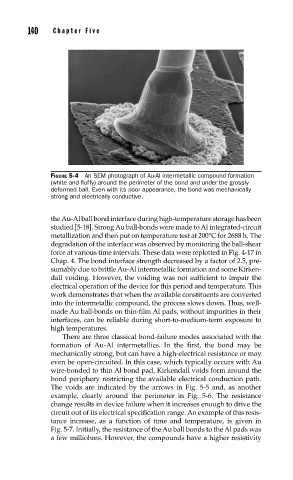
              FIGURE 5-4  An SEM photograph of Au-Al intermetallic compound formation
              (white and fl uffy) around the perimeter of the bond and under the grossly
              deformed ball. Even with its poor appearance, the bond was mechanically
              strong and electrically conductive.

              the Au-Al ball bond interface during high-temperature storage has been
              studied [5-18]. Strong Au ball-bonds were made to Al integrated-circuit
              metallization and then put on temperature test at 200°C for 2688 h. The
              degradation of the interface was observed by monitoring the ball-shear
              force at various time intervals. These data were replotted in Fig. 4-17 in
              Chap. 4. The bond interface strength decreased by a factor of 2.5, pre-
              sumably due to brittle Au-Al intermetallic formation and some Kirken-
              dall voiding. However, the voiding was not sufficient to impair the
              electrical operation of the device for this period and temperature. This
              work demonstrates that when the available constituents are converted
              into the intermetallic compound, the process slows down. Thus, well-
              made Au ball-bonds on thin-film Al pads, without impurities in their
              interfaces, can be reliable during short-to-medium-term exposure to
              high temperatures.
                 There are three classical bond-failure modes associated with the
              formation of  Au-Al intermetallics. In the first, the bond may be
              mechanically strong, but can have a high-electrical resistance or may
              even be open-circuited. In this case, which typically occurs with Au
              wire-bonded to thin Al bond pad, Kirkendall voids form around the
              bond periphery restricting the available electrical conduction path.
              The voids are indicated by the arrows in Fig. 5-5 and, as another
              example, clearly around the perimeter  in Fig. 5-6.  The resistance
              change results in device failure when it increases enough to drive the
              circuit out of its electrical specification range. An example of this resis-
              tance increase, as a function of time and temperature, is given in
              Fig. 5-7. Initially, the resistance of the Au ball bonds to the Al pads was
              a few milliohms. However, the compounds have a higher resistivity

