


Page 165 - Wire Bonding in Microelectronics
P. 165
142    Cha pte r  F i v e


                       10
                        Ω


                        1

                   ∆R
                       0.1


                      0.01


                                   10 3              10 4   h
                                          t

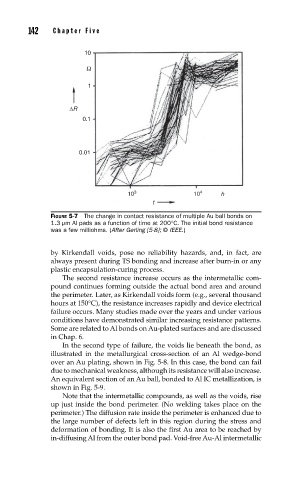
              FIGURE 5-7  The change in contact resistance of multiple Au ball bonds on
              1.3 µm Al pads as a function of time at 200°C. The initial bond resistance
              was a few milliohms. (After Gerling [5-8]; © IEEE.)


              by Kirkendall voids, pose no reliability hazards, and, in fact, are
              always present during TS bonding and increase after burn-in or any
              plastic encapsulation-curing process.
                 The second resistance increase occurs as the intermetallic com-
              pound continues forming outside the actual bond area and around
              the perimeter. Later, as Kirkendall voids form (e.g., several thousand
              hours at 150°C), the resistance increases rapidly and device electrical
              failure occurs. Many studies made over the years and under various
              conditions have demonstrated similar increasing resistance patterns.
              Some are related to Al bonds on Au-plated surfaces and are discussed
              in Chap. 6.
                 In the second type of failure, the voids lie beneath the bond, as
              illustrated in the metallurgical cross-section of an Al wedge-bond
              over an Au plating, shown in Fig. 5-8. In this case, the bond can fail
              due to mechanical weakness, although its resistance will also increase.
              An equivalent section of an Au ball, bonded to Al IC metallization, is
              shown in Fig. 5-9.
                 Note that the intermetallic compounds, as well as the voids, rise
              up just inside the bond perimeter. (No welding takes place on the
              perimeter.) The diffusion rate inside the perimeter is enhanced due to
              the large number of defects left in this region during the stress and
              deformation of bonding. It is also the first Au area to be reached by
              in-diffusing Al from the outer bond pad. Void-free Au-Al intermetallic

