


Page 160 - Wire Bonding in Microelectronics
P. 160
Gold-Aluminum Intermetallic Compounds       137


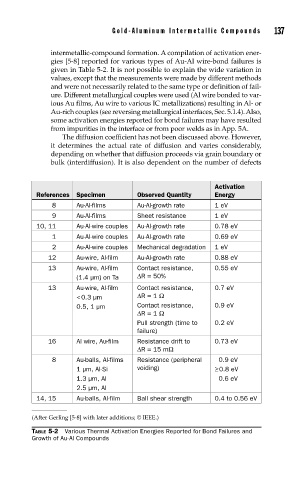
              intermetallic-compound formation. A compilation of activation ener-
              gies [5-8] reported for various types of Au-Al wire-bond failures is
              given in Table 5-2. It is not possible to explain the wide variation in
              values, except that the measurements were made by different methods
              and were not necessarily related to the same type or definition of fail-
              ure. Different metallurgical couples were used (Al wire bonded to var-
              ious Au films, Au wire to various IC metallizations) resulting in Al- or
              Au-rich couples (see reversing metallurgical interfaces, Sec. 5.1.4). Also,
              some activation energies reported for bond failures may have resulted
              from impurities in the interface or from poor welds as in App. 5A.
                 The diffusion coefficient has not been discussed above. However,
              it determines the actual rate of diffusion and varies considerably,
              depending on whether that diffusion proceeds via grain boundary or
              bulk (interdiffusion). It is also dependent on the number of defects


                                                           Activation
          References  Specimen        Observed Quantity    Energy
              8      Au-Al-films      Au-Al-growth rate    1 eV
              9      Au-Al-films      Sheet resistance     1 eV
          10, 11     Au-Al-wire couples  Au-Al-growth rate  0.78 eV
              1      Au-Al-wire couples  Au-Al-growth rate  0.69 eV
              2      Au-Al-wire couples  Mechanical degradation  1 eV
             12      Au-wire, Al-film  Au-Al-growth rate   0.88 eV
             13      Au-wire, Al-film  Contact resistance,  0.55 eV
                     (1.4 µm) on Ta   ∆R = 50%
             13      Au-wire, Al-film  Contact resistance,  0.7 eV
                     < 0.3 µm         ∆R = 1 Ω
                     0.5, 1 µm        Contact resistance,  0.9 eV
                                      ∆R = 1 Ω
                                      Pull strength (time to   0.2 eV
                                      failure)
             16      Al wire, Au-film  Resistance drift to  0.73 eV
                                      ∆R = 15 mΩ
              8      Au-balls, Al-films  Resistance (peripheral     0.9 eV
                     1 µm, Al-Si      voiding)             ≥ 0.8 eV
                     1.3 µm, Al                              0.6 eV
                     2.5 µm, Al
          14, 15     Au-balls, Al-film  Ball shear strength  0.4 to 0.56 eV

         (After Gerling [5-8] with later additions; © IEEE.)

         TABLE 5-2  Various Thermal Activation Energies Reported for Bond Failures and
         Growth of Au-Al Compounds

