


Page 161 - Wire Bonding in Microelectronics
P. 161
138    Cha pte r  F i v e


              available (the more defects, the faster diffusion proceeds). Aluminum
              and other metals diffuse very rapidly into Au by grain-boundary dif-
              fusion. A discussion of this is given in Sec. 6A.4. It should be noted that
              the specific intermetallic compounds in a bond-interface area are
              related to the relative amounts of Au and Al present and can be differ-
              ent if Al metallization contains Cu or Si in the 1 to 2% level. In addition,
              some compounds may be absent because of a low nucleation probabil-
              ity (they do not get started) or they may grow very slowly and are not
              observed.
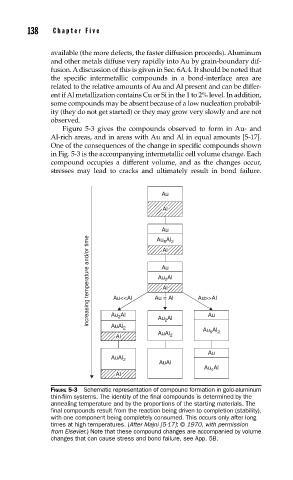
                 Figure 5-3 gives the compounds observed to form in Au- and
              Al-rich areas, and in areas with Au and Al in equal amounts [5-17].
              One of the consequences of the change in specific compounds shown
              in Fig. 5-3 is the accompanying intermetallic cell volume change. Each
              compound occupies a different volume, and as the changes occur,
              stresses may lead to cracks and ultimately result in bond failure.


                                            Au

                                            Al

                                            Au  2
                        Increasing temperature and/or time  Au<<Al  Au = Al  Au>>Al
                                           Au Al
                                             5
                                            Al

                                            Au
                                           Au Al
                                             2
                                            Al


                              Au Al
                                                         Au
                                2
                                           Au Al
                                             2
                              AuAl
                                  2
                                                       Au Al 2
                                                         5
                                Al         AuAl 2
                                                         Au
                              AuAl 2
                                            AuAl
                                                          Al
                                                        Au 4
                                Al
              FIGURE 5-3  Schematic representation of compound formation in gold-aluminum
              thin-fi lm systems. The identity of the fi nal compounds is determined by the
              annealing temperature and by the proportions of the starting materials. The
              fi nal compounds result from the reaction being driven to completion (stability),
              with one component being completely consumed. This occurs only after long
              times at high temperatures. (After Majni [5-17]; © 1970, with permission
              from Elsevier.) Note that these compound changes are accompanied by volume
              changes that can cause stress and bond failure, see App. 5B.

