


Page 164 - Wire Bonding in Microelectronics
P. 164
Gold-Aluminum Intermetallic Compounds       141


                                                    1µ


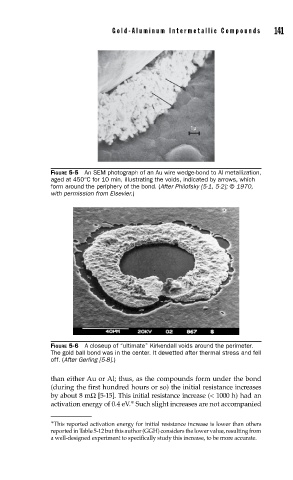
              FIGURE 5-5  An SEM photograph of an Au wire wedge-bond to Al metallization,
              aged at 450°C for 10 min, illustrating the voids, indicated by arrows, which
              form around the periphery of the bond. (After Philofsky [5-1, 5-2]; © 1970,
              with permission from Elsevier.)


              FIGURE 5-6  A closeup of “ultimate” Kirkendall voids around the perimeter.
              The gold ball bond was in the center. It dewetted after thermal stress and fell
              off. (After Gerling [5-8].)

              than either Au or Al; thus, as the compounds form under the bond
              (during the first hundred hours or so) the initial resistance increases
              by about 8 mΩ [5-15]. This initial resistance increase (< 1000 h) had an
              activation energy of 0.4 eV. ∗  Such slight increases are not accompanied

              ∗ This reported activation energy for initial resistance increase is lower than others
              reported in Table 5-12 but this author (GGH) considers the lower value, resulting from
              a well-designed experiment to specifically study this increase, to be more accurate.

