


Page 168 - Wire Bonding in Microelectronics
P. 168
Gold-Aluminum Intermetallic Compounds       145


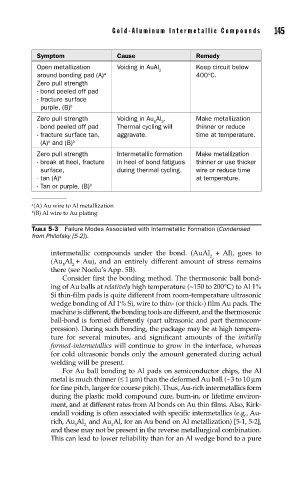
          Symptom               Cause                 Remedy
          Open metallization    Voiding in AuAl       Keep circuit below
                                            2
          around bonding pad (A) a                    400°C.
          Zero pull strength
          - bond peeled off pad
          - fracture surface
           purple, (B) b
          Zero pull strength    Voiding in Au Al .    Make metallization
                                          5  2
          - bond peeled off pad  Thermal cycling will   thinner or reduce
          - fracture surface tan,  aggravate.         time at temperature.
             a
           (A)  and (B) b
          Zero pull strength    Intermetallic formation   Make metallization
          - break at heel, fracture   in heel of bond fatigues   thinner or use thicker
           surface,             during thermal cycling.  wire or reduce time
          - tan (A) a                                 at temperature.
          - Tan or purple, (B) b

         a (A) Au wire to Al metallization
         b (B) Al wire to Au plating

         TABLE 5-3  Failure Modes Associated with Intermetallic Formation (Condensed
         from Philofsky [5-2]).

              intermetallic compounds under the bond. (AuAl   +  Al), goes to
                                                         2
              (Au Al +  Au), and an entirely different amount of stress remains
                 5  2
              there (see Noolu’s App. 5B).
                 Consider first the bonding method. The thermosonic ball bond-
              ing of Au balls at relatively high temperature (~150 to 200°C) to Al 1%
              Si thin-film pads is quite different from room-temperature ultrasonic
              wedge bonding of Al 1% Si, wire to thin- (or thick-) film Au pads. The
              machine is different, the bonding tools are different, and the thermosonic
              ball-bond is formed differently (part ultrasonic and part thermocom-
              pression). During such bonding, the package may be at high tempera-
              ture for several minutes, and significant amounts of the initially
              formed-intermetallics will continue to grow in the interface, whereas
              for cold ultrasonic bonds only the amount generated during actual
              welding will be present.
                 For Au ball bonding to Al pads on semiconductor chips, the Al
              metal is much thinner (≤ 1 µm) than the deformed Au ball (~3 to 10 µm
              for fine pitch, larger for course pitch). Thus, Au-rich intermetallics form
              during the plastic mold compound cure, burn-in, or lifetime environ-
              ment, and at different rates from Al bonds on Au thin films. Also, Kirk-
              endall voiding is often associated with specific intermetallics (e.g., Au-
              rich, Au Al  and Au Al, for an Au bond on Al metallization) [5-1, 5-2],
                    5  2,     4
              and these may not be present in the reverse metallurgical combination.
              This can lead to lower reliability than for an Al wedge bond to a pure

