


Page 166 - Wire Bonding in Microelectronics
P. 166
Gold-Aluminum Intermetallic Compounds       143


                        Al wire
                                      Line of voids


                         Intermetallic


                                                         10 µ
                         Au plating

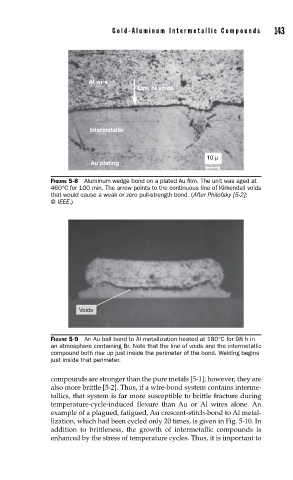
              FIGURE 5-8  Aluminum wedge bond on a plated Au fi lm. The unit was aged at
              460°C for 100 min. The arrow points to the continuous line of Kirkendall voids
              that would cause a weak or zero pull-strength bond. (After Philofsky [5-2];
              © IEEE.)


                      Voids


              FIGURE 5-9  An Au ball bond to Al metallization heated at 180°C for 98 h in
              an atmosphere containing Br. Note that the line of voids and the intermetallic
              compound both rise up just inside the perimeter of the bond. Welding begins
              just inside that perimeter.

              compounds are stronger than the pure metals [5-1]; however, they are
              also more brittle [5-2]. Thus, if a wire-bond system contains interme-
              tallics, that system is far more susceptible to brittle fracture during
              temperature-cycle-induced flexure than  Au or  Al wires alone.  An
              example of a plagued, fatigued, Au crescent-stitch-bond to Al metal-
              lization, which had been cycled only 20 times, is given in Fig. 5-10. In
              addition to brittleness, the growth of intermetallic compounds is
              enhanced by the stress of temperature cycles. Thus, it is important to

