


Page 484 - Advanced Organic Chemistry Part A - Structure and Mechanisms, 5th ed (2007) - Carey _ Sundberg
P. 484
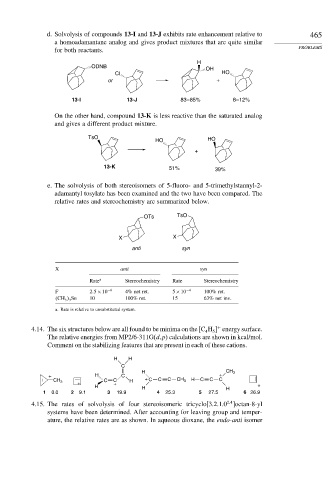
d. Solvolysis of compounds 13-I and 13-J exhibits rate enhancement relative to  465
                 a homoadamantane analog and gives product mixtures that are quite similar
                 for both reactants.                                                       PROBLEMS
                                                            H
                            ODNB
                                                               OH
                                    Cl                              HO
                                 or                               +

                       13-I            13-J            83 – 85%        8 – 12%

                 On the other hand, compound 13-K is less reactive than the saturated analog
                 and gives a different product mixture.
                            TsO                                HO
                                                HO
                                                            +

                                13-K                51%           39%

               e. The solvolysis of both stereoisomers of 5-fluoro- and 5-trimethylstannyl-2-
                 adamantyl tosylate has been examined and the two have been compared. The
                 relative rates and stereochemistry are summarized below.

                                            OTs       TsO


                                     X               X
                                         anti           syn


                  X                  anti                    syn
                            Rate a     Stereochemistry  Rate  Stereochemistry
                  F         2 5×10 −6  4% net ret.   5×10 −4  100% ret.
                   CH 3   3 Sn  10     100% ret.     15       63% net inv.
                  a. Rate is relative to unsubstituted system.

                                                                  +
          4.14. The six structures below are all found to be minima on the  C H   energy surface.
                                                               4
                                                                 5
               The relative energies from MP2/6-311G(d,p) calculations are shown in kcal/mol.
               Comment on the stabilizing features that are present in each of these cations.
                                   H    H
                                     C
                                            H                        CH 3
                +             H      C                             +
                                C  C         + C  C  C  CH 3  H  C  C  C
                 CH 3                   H
                        +          +
                             H              H                        H        +
              1  0.0  2  9.1     3  19.9        4  25.3      5  27.5      6 26.9
                                                                     2 4
          4.15. The rates of solvolysis of four stereoisomeric tricyclo[3.2.1.0 ]octan-8-yl
               systems have been determined. After accounting for leaving group and temper-
               ature, the relative rates are as shown. In aqueous dioxane, the endo-anti isomer

