


Page 533 -
P. 533
QUEUING SIMULATION  513


                                      Referring to Figure 12.10, we see that the simulation is initialized in the first block of
                                      the flowchart. Then a new customer arriving is simulated. An interarrival time is
                                                                                                   2
                                      generated to determine the time since the preceding customer arrived. The arrival
                                      time for the new customer is then calculated by adding the interarrival time to the
                                      arrival time of the preceding customer.
                      The decision rule for  The arrival time for the new customer must be compared to the completion time
                      deciding whether the  of the preceding customer to determine whether the ATM is idle or busy. If the
                      ATM is idle or busy is the  arrival time of the new customer is greater than the completion time of the preced-
                      most difficult aspect of
                      the logic in a queuing  ing customer, the preceding customer will have finished service prior to the arrival of
                      simulation model.  the new customer. In this case, the ATM will be idle, and the new customer can
                                      begin service immediately. The service start time for the new customer is equal to
                                      the arrival time of the new customer. However, if the arrival time for the new
                                      customer is not greater than the completion time of the preceding customer, the
                                      new customer arrived before the preceding customer finished service. In this case,
                                      the ATM is busy; the new customer must wait to use the ATM until the preceding
                                      customer completes service. The service start time for the new customer is equal to
                                      the completion time of the preceding customer.
                                         Note that the time the new customer has to wait to use the ATM is the difference
                                      between the customer’s service start time and the customer’s arrival time. At this
                                      point, the customer is ready to use the ATM, and the simulation run continues with
                                      the generation of the customer’s service time. The time at which the customer begins
                                      service plus the service time generated determine the customer’s completion time.
                                      Finally, the total time the customer spends in the system is the difference between
                                      the customer’s service completion time and the customer’s arrival time. At this
                                      point, the computations are complete for the current customer, and the simulation
                                      continues with the next customer. The simulation is continued until a specified
                                      number of customers have been served by the ATM.
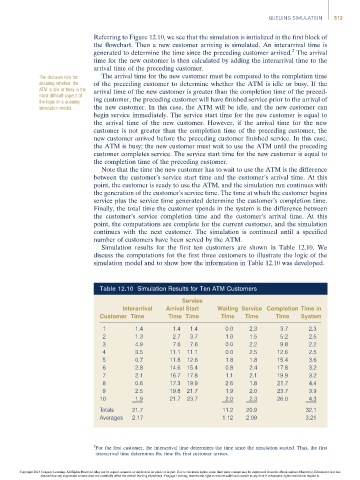
                                         Simulation results for the first ten customers are shown in Table 12.10. We
                                      discuss the computations for the first three customers to illustrate the logic of the
                                      simulation model and to show how the information in Table 12.10 was developed.


                                        Table 12.10 Simulation Results for Ten ATM Customers

                                                                 Service
                                               Interarrival  Arrival Start  Waiting Service Completion Time in
                                        Customer Time        Time Time       Time    Time     Time    System
                                         1         1.4         1.4  1.4        0.0    2.3       3.7     2.3
                                         2         1.3         2.7  3.7        1.0    1.5       5.2     2.5
                                         3         4.9         7.6  7.6        0.0    2.2       9.8     2.2
                                         4         3.5        11.1  11.1       0.0    2.5      12.6     2.5
                                         5         0.7        11.8  12.6       1.8    1.8      15.4     3.6
                                         6         2.8        14.6  15.4       0.8    2.4      17.8     3.2
                                         7         2.1        16.7  17.8       1.1    2.1      19.9     3.2
                                         8         0.6        17.3  19.9       2.6    1.8      21.7     4.4
                                         9         2.5        19.8  21.7       1.9    2.0      23.7     3.9
                                        10         1.9        21.7  23.7       2.0    2.3      26.0     4.3

                                        Totals    21.7                        11.2   20.9              32.1
                                        Averages  2.17                        1.12   2.09              3.21


                                      2
                                       For the first customer, the interarrival time determines the time since the simulation started. Thus, the first
                                       interarrival time determines the time the first customer arrives.

                Copyright 2014 Cengage Learning. All Rights Reserved. May not be copied, scanned, or duplicated, in whole or in part. Due to electronic rights, some third party content may be suppressed from the eBook and/or eChapter(s). Editorial review has
                      deemed that any suppressed content does not materially affect the overall learning experience. Cengage Learning reserves the right to remove additional content at any time if subsequent rights restrictions require it.

