


Page 117 -
P. 117
90  CHAPTER 3 / A TOP-LEVEL VIEW OF COMPUTER FUNCTION

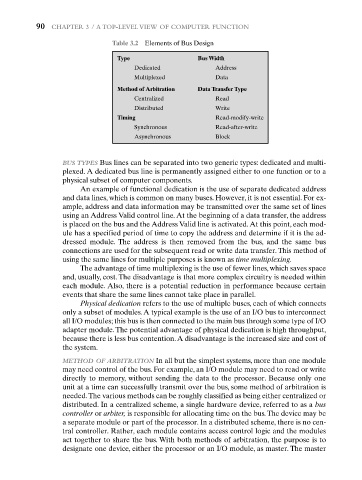
                                Table 3.2 Elements of Bus Design

                                 Type                  Bus Width
                                      Dedicated             Address
                                      Multiplexed           Data
                                 Method of Arbitration  Data Transfer Type
                                      Centralized           Read
                                      Distributed           Write
                                 Timing                     Read-modify-write
                                      Synchronous           Read-after-write
                                      Asynchronous          Block


                  BUS TYPES Bus lines can be separated into two generic types: dedicated and multi-
                  plexed. A dedicated bus line is permanently assigned either to one function or to a
                  physical subset of computer components.
                       An example of functional dedication is the use of separate dedicated address
                  and data lines, which is common on many buses. However, it is not essential. For ex-
                  ample, address and data information may be transmitted over the same set of lines
                  using an Address Valid control line. At the beginning of a data transfer, the address
                  is placed on the bus and the Address Valid line is activated.At this point, each mod-
                  ule has a specified period of time to copy the address and determine if it is the ad-
                  dressed module. The address is then removed from the bus, and the same bus
                  connections are used for the subsequent read or write data transfer.This method of
                  using the same lines for multiple purposes is known as time multiplexing.
                       The advantage of time multiplexing is the use of fewer lines, which saves space
                  and, usually, cost. The disadvantage is that more complex circuitry is needed within
                  each module. Also, there is a potential reduction in performance because certain
                  events that share the same lines cannot take place in parallel.
                       Physical dedication refers to the use of multiple buses, each of which connects
                  only a subset of modules.A typical example is the use of an I/O bus to interconnect
                  all I/O modules; this bus is then connected to the main bus through some type of I/O
                  adapter module. The potential advantage of physical dedication is high throughput,
                  because there is less bus contention.A disadvantage is the increased size and cost of
                  the system.
                  METHOD OF ARBITRATION In all but the simplest systems, more than one module
                  may need control of the bus. For example, an I/O module may need to read or write
                  directly to memory, without sending the data to the processor. Because only one
                  unit at a time can successfully transmit over the bus, some method of arbitration is
                  needed.The various methods can be roughly classified as being either centralized or
                  distributed. In a centralized scheme, a single hardware device, referred to as a bus
                  controller or arbiter, is responsible for allocating time on the bus.The device may be
                  a separate module or part of the processor. In a distributed scheme, there is no cen-
                  tral controller. Rather, each module contains access control logic and the modules
                  act together to share the bus. With both methods of arbitration, the purpose is to
                  designate one device, either the processor or an I/O module, as master. The master

