


Page 119 -
P. 119
92  CHAPTER 3 / A TOP-LEVEL VIEW OF COMPUTER FUNCTION

                  clock cycle and may assert various status lines. Once the address lines have stabi-
                  lized, the processor issues an address enable signal. For a read operation, the
                  processor issues a read command at the start of the second cycle. A memory mod-
                  ule recognizes the address and, after a delay of one cycle, places the data on the
                  data lines.The processor reads the data from the data lines and drops the read sig-
                  nal. For a write operation, the processor puts the data on the data lines at the start
                  of the second cycle, and issues a write command after the data lines have stabi-
                  lized. The memory module copies the information from the data lines during the
                  third clock cycle.
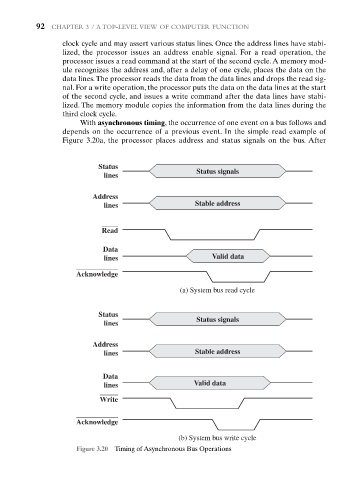
                       With asynchronous timing, the occurrence of one event on a bus follows and
                  depends on the occurrence of a previous event. In the simple read example of
                  Figure 3.20a, the processor places address and status signals on the bus. After


                            Status
                                                       Status signals
                             lines

                          Address
                             lines                    Stable address


                             Read

                             Data
                             lines                         Valid data
                      Acknowledge

                                                  (a) System bus read cycle


                            Status
                                                       Status signals
                             lines

                          Address
                             lines                    Stable address


                             Data
                             lines                    Valid data

                            Write


                      Acknowledge
                                                  (b) System bus write cycle
                      Figure 3.20  Timing of Asynchronous Bus Operations

