


Page 118 -
P. 118
3.4 / BUS INTERCONNECTION 91

                  may then initiate a data transfer (e.g., read or write) with some other device, which
                  acts as slave for this particular exchange.
                  TIMING Timing refers to the way in which events are coordinated on the bus. Buses
                  use either synchronous timing or asynchronous timing.
                       With synchronous timing, the occurrence of events on the bus is determined
                  by a clock.The bus includes a clock line upon which a clock transmits a regular se-
                  quence of alternating 1s and 0s of equal duration. A single 1–0 transmission is re-
                  ferred to as a clock cycle or bus cycle and defines a time slot. All other devices on
                  the bus can read the clock line, and all events start at the beginning of a clock
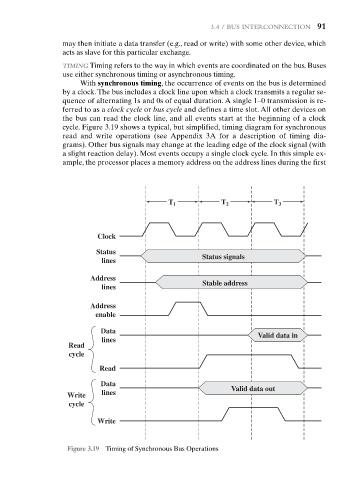
                  cycle. Figure 3.19 shows a typical, but simplified, timing diagram for synchronous
                  read and write operations (see  Appendix 3A for a description of timing dia-
                  grams). Other bus signals may change at the leading edge of the clock signal (with
                  a slight reaction delay). Most events occupy a single clock cycle. In this simple ex-
                  ample, the processor places a memory address on the address lines during the first


                                               T 1           T 2            T 3


                            Clock

                           Status
                                                        Status signals
                             lines
                          Address
                                                         Stable address
                                                        Stable address
                             lines
                          Address
                           enable

                             Data
                                                                       Valid data in
                             lines
                    Read
                    cycle
                            Read

                             Data
                                                                Valid data out
                   Write     lines
                    cycle


                            Write


                   Figure 3.19  Timing of Synchronous Bus Operations

