


Page 432 - Excel 2007 Bible
P. 432
26_044039 ch20.qxp  11/21/06  11:11 AM  Page 389
                                                                                              Learning Advanced Charting
                                             Working with the Legend
                                             A chart’s legend consists of text and keys that make it easier to identify the data series. A key is a small
                                             graphic that corresponds to the chart’s series (one key for each series).
                                             To add a legend to your chart, choose Chart Tools ➪ Layout ➪ Labels ➪ Legend. This drop-down control
                                            contains several options for the legend placement. After you’ve added a legend, you can drag it to move it
                                            anywhere you like.
                                                       If you move a legend from its default position, you may want to change the size of the Plot
                                           TIP
                                           TIP
                                                       Area to fill in the gap left by the legend. Just select the Plot Area and drag a border to make it
                                            the desired size.
                                             The quickest way to remove a legend is to select the legend and then press Delete.
                                             You can select individual items within a legend and format them separately. For example, you may want to
                                             make the text bold to draw attention to a particular data series. To select an element in the legend, first
                                             select the legend and then click the desired element.
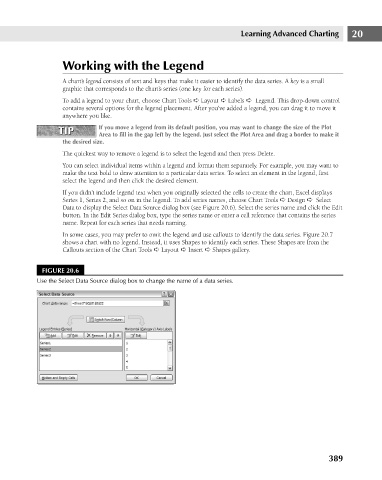
                                             If you didn’t include legend text when you originally selected the cells to create the chart, Excel displays
                                             Series 1, Series 2, and so on in the legend. To add series names, choose Chart Tools ➪ Design ➪ Select
                                            Data to display the Select Data Source dialog box (see Figure 20.6). Select the series name and click the Edit  20
                                            button. In the Edit Series dialog box, type the series name or enter a cell reference that contains the series
                                            name. Repeat for each series that needs naming.
                                            In some cases, you may prefer to omit the legend and use callouts to identify the data series. Figure 20.7
                                            shows a chart with no legend. Instead, it uses Shapes to identify each series. These Shapes are from the
                                            Callouts section of the Chart Tools ➪ Layout ➪ Insert ➪ Shapes gallery.
                                       FIGURE 20.6
                                     Use the Select Data Source dialog box to change the name of a data series.


                                                                                                                      389

