


Page 148 - Fundamentals of Water Treatment Unit Processes : Physical, Chemical, and Biological
P. 148
Sedimentation                                                                                    103


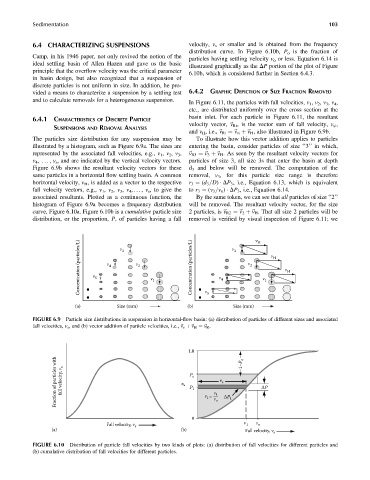
            6.4 CHARACTERIZING SUSPENSIONS                     velocity, v s or smaller and is obtained from the frequency
                                                               distribution curve. In Figure 6.10b, P o is the fraction of
            Camp, in his 1946 paper, not only revived the notion of the
                                                               particles having settling velocity v o or less. Equation 6.14 is
            ideal settling basin of Allen Hazen and gave us the basic
                                                               illustrated graphically as the DP portion of the plot of Figure
            principle that the overflow velocity was the critical parameter
                                                               6.10b, which is considered further in Section 6.4.3.
            in basin design, but also recognized that a suspension of
            discrete particles is not uniform in size. In addition, he pro-
            vided a means to characterize a suspension by a settling test  6.4.2 GRAPHIC DEPICTION OF SIZE FRACTION REMOVED
            and to calculate removals for a heterogeneous suspension.
                                                               In Figure 6.11, the particles with fall velocities, v 1 , v 2 , v 3 , v 4 ,
                                                               etc., are distributed uniformly over the cross section at the
                                                               basin inlet. For each particle in Figure 6.11, the resultant
            6.4.1 CHARACTERISTICS OF DISCRETE PARTICLE
                                                               velocity vector, ~ v Ri , is the vector sum of fall velocity, v si ,
                   SUSPENSIONS AND REMOVAL ANALYSIS
                                                               and v H , i.e., ~ v Ri ¼~ v si þ~ v H , also illustrated in Figure 6.9b.
            The particles size distribution for any suspension may be  To illustrate how this vector addition applies to particles
            illustrated by a histogram, such as Figure 6.9a. The sizes are  entering the basin, consider particles of size ‘‘3’’ in which,
            represented by the associated fall velocities, e.g., v 1 , v 2 , v 3 ,  ~ v R3 ¼~ v 3 þ~ v H . As seen by the resultant velocity vectors for
            v 4 , ... , v s , and are indicated by the vertical velocity vectors.  particles of size 3, all size 3s that enter the basin at depth
            Figure 6.9b shows the resultant velocity vectors for these  d 3 and below will be removed. The computation of the
            same particles in a horizontal flow settling basin. A common  removal, v 3 , for this particle size range is therefore
                                                                      =
            horizontal velocity, v H , is added as a vector to the respective  r 3 ¼ (d 3 D)   DP 3 , i.e., Equation 6.13, which is equivalent
                                                                        =
            fall velocity vectors, e.g., v 1 , v 2 , v 3 , v 4 ,. .., v s , to give the  to r 3 ¼ (v 3 v o )   DP 3 , i.e., Equation 6.14.
            associated resultants. Plotted as a continuous function, the  By the same token, we can see that all particles of size ‘‘2’’
            histogram of Figure 6.9a becomes a frequency distribution  will be removed. The resultant velocity vector, for the size
            curve, Figure 6.10a. Figure 6.10b is a cumulative particle size  2 particles, is ~ v R2 ¼~ v 2 þ~ v H . That all size 2 particles will be
            distribution, or the proportion, P, of particles having a fall  removed is verified by visual inspection of Figure 6.11; we


                                                                                     v
                           Concentration (particles/L)  v 5  v 4  v 3  v 2  v 1  Concentration (particles/L)  v 4  v 3  v 2  v 1  v H  v H
                                                                                      H


                          (a)           Size (mm)              (b)  v 5       Size (mm)

            FIGURE 6.9 Particle size distributions in suspension in horizontal-flow basin: (a) distribution of particles of different sizes and associated
            fall velocities, v s , and (b) vector addition of particle velocities, i.e., ~ v s þ~ v H ¼~ v R .


                                                               1.0               1–P o
                   Fraction of particles with    fall velocity, v s  P  P o 1  r =  v 1  v s ΔP 1  ΔP


                                                               P
                                                                     1


                                                                0      v o
                                    Fall velocity, v s                           v 1  v o
                  (a)                                        (b)
                                                                                  Fall velocity, v s
            FIGURE 6.10 Distribution of particle fall velocities by two kinds of plots: (a) distribution of fall velocities for different particles and
            (b) cumulative distribution of fall velocities for different particles.

