


Page 149 - Fundamentals of Water Treatment Unit Processes : Physical, Chemical, and Biological
P. 149
104                            Fundamentals of Water Treatment Unit Processes: Physical, Chemical, and Biological


                                                                                   1=24
                                                                                   2=20
                                                           v 2                     3=24
                                                                  v H              4=18
                              D                                                    5=20
                                                           v 3       v R2
                                                                                 Total = 106
                               d 3
                                                                  v H
                                                                     v R3


                              r   = d /D ·ΔP    L
                                       3
                              3
                                  3
                                = 3/5·24 particles
                                = 15 particles

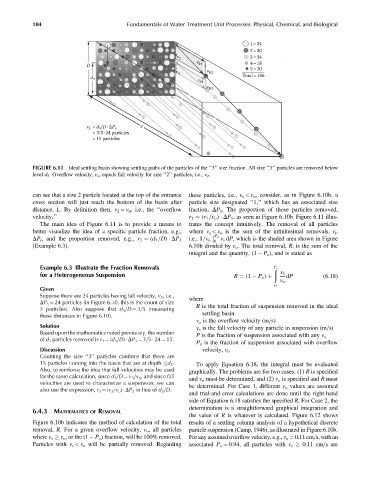
            FIGURE 6.11  Ideal settling basin showing settling paths of the particles of the ‘‘3’’ size fraction. All size ‘‘3’’ particles are removed below
            level d 3 . Overflow velocity, v o , equals fall velocity for size ‘‘2’’ particles, i.e., v 2 .


            can see that a size 2 particle located at the top of the entrance  these particles, i.e., v s < v o , consider, as in Figure 6.10b, a
            cross section will just reach the bottom of the basin after  particle size designated ‘‘1,’’ which has an associated size
            distance, L.Bydefinition then, v 2 ¼ v o , i.e., the ‘‘overflow  fraction, DP 1 . The proportion of those particles removed,
                                                                      =
            velocity.’’                                        r 1 ¼ (v 1 v o )   DP 1 , as seen in Figure 6.10b. Figure 6.11 illus-
              The main idea of Figure 6.11 is to provide a means to  trates the concept intuitively. The removal of all particles
            better visualize the idea of a specific particle fraction, e.g.,  where v s < v o is the sum of the infinitesimal removals, r i ,
                                                                       Ð
                                                     =                  P o  v s dP, which is the shaded area shown in Figure
            DP i , and the proportion removed, e.g., r 3 ¼ (d 3 D)   DP 3  i.e., 1=v o 0
            (Example 6.3).                                     6.10b divided by v o . The total removal, R, is the sum of the
                                                               integral and the quantity, (1   P o ), and is stated as
              Example 6.3 Illustrate the Fraction Removals                                 P ð o
              for a Heterogeneous Suspension                                                 v s  dP       (6:18)
                                                                              R ¼ (1   P o ) þ
                                                                                             v o
                                                                                           0
              Given
              Suppose there are 24 particles having fall velocity, v 3 , i.e.,  where
              DP 3 ¼ 24 particles (in Figure 6.10, this is the count of size
              3 particles). Also suppose that d 3 =D ¼ 3=5 (measuring  R is the total fraction of suspension removed in the ideal
              these distances in Figure 6.10).                      settling basin
                                                                  v o is the overflow velocity (m=s)
              Solution                                            v s is the fall velocity of any particle in suspension (m=s)
              Based upon the mathematics noted previously, the number
                                                                  P is the fraction of suspension associated with any v s
              of d 3 particles removed is r 3 ¼ (d 3 =D)   DP 3 ¼ 3=5   24 ¼ 15.
                                                                  P o is the fraction of suspension associated with overflow
              Discussion                                            velocity, v o
              Counting the size ‘‘3’’ particles confirms that there are
              15 particles coming into the basin that are at depth  d 3 .  To apply Equation 6.18, the integral must be evaluated
              Also, to reinforce the idea that fall velocities may be used
                                                               graphically. The problems are for two cases: (1) R is specified
              for the same calculation, since d 3 =D ¼ v 3 =v o , and since fall  and v o must be determined, and (2) v o is specified and R must
              velocities are used to characterize a suspension, we can
              also use the expression, r 3 ¼ (v 3 =v o )   DP 3 in lieu of d 3 =D.  be determined. For Case 1, different v o values are assumed
                                                               and trial-and-error calculations are done until the right-hand
                                                               side of Equation 6.18 satisfies the specified R. For Case 2, the
                                                               determination is a straightforward graphical integration and
            6.4.3 MATHEMATICS OF REMOVAL
                                                               the value of R is whatever is calculated. Figure 6.12 shows
            Figure 6.10b indicates the method of calculation of the total  results of a settling column analysis of a hypothetical discrete
            removal, R. For a given overflow velocity, v o , all particles  particle suspension (Camp, 1946), as illustrated in Figure 6.10b.
            where v s   v o , or the (1   P o ) fraction, will be 100% removed.  For any assumed overflow velocity, e.g., v o ¼ 0.11 cm=s, with an
            Particles with v s < v o will be partially removed. Regarding  associated P o ¼ 0.94, all particles with v s   0.11 cm=s are

