


Page 485 - Industrial Wastewater Treatment, Recycling and Reuse
P. 485
3D TRASAR™ Technologies for Reliable Wastewater Recycling, and Reuse  455


                 permeate flow and normalized differential pressure data for an RO sys-
                 tem and indicates the times when the system should have been cleaned
                 (based on the rules mentioned earlier). The RO system was not cleaned
                 at the recommended time, while at other instances the cleaning was
                 done but was not enough. This caused steep deterioration in the perfor-
                 mance of the RO system, forcing membrane replacement to occur,
                 because the permeate flow diminished to a point where enough water
                 could no longer be produced. 3D TRASAR Membrane Technology
                 monitors these normalized parameters and sends regular reports outlin-
                 ing these changes and upcoming actions.
              C. Reduce risk for chlorine exposure.
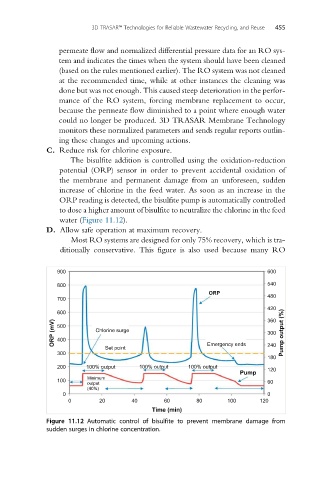
                    The bisulfite addition is controlled using the oxidation-reduction
                 potential (ORP) sensor in order to prevent accidental oxidation of
                 the membrane and permanent damage from an unforeseen, sudden
                 increase of chlorine in the feed water. As soon as an increase in the
                 ORP reading is detected, the bisulfite pump is automatically controlled
                 to dose a higher amount of bisulfite to neutralize the chlorine in the feed
                 water (Figure 11.12).
              D. Allow safe operation at maximum recovery.
                    Most RO systems are designed for only 75% recovery, which is tra-
                 ditionally conservative. This figure is also used because many RO


                900                                                      600
                800                                                      540
                                                         ORP
                700                                                      480
                                                                         420
                600                                                      360
                ORP (mV)  500  Chlorine surge                            300  Pump output (%)

                400
                             Set point                   Emergency ends  240
                300
                                                                         180
                200     100% output    100% output  100% output          120
                                                                  Pump
                         Minimum
                100                                                      60
                         output
                         (40%)
                  0                                                      0
                    0       20       40      60       80      100      120
                                          Time (min)
              Figure 11.12 Automatic control of bisulfite to prevent membrane damage from
              sudden surges in chlorine concentration.

