


Page 486 - Industrial Wastewater Treatment, Recycling and Reuse
P. 486
456   Industrial Wastewater Treatment, Recycling, and Reuse


              systems are not maintained properly since the operators are often not
              skilled or knowledgeable. Due to these concerns, RO systems are con-
              servatively designed so as to avoid having to replace the membranes
              more often as opposed to the preservation of water (by running at higher
              recovery). Lower recovery means more feed water is needed and more
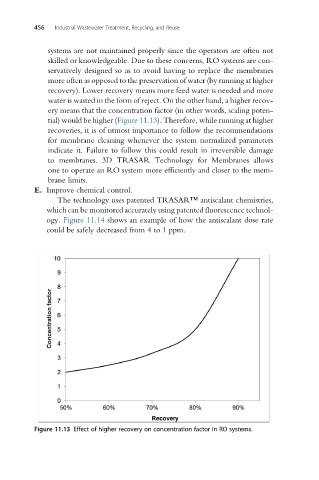
              water is wasted in the form of reject. On the other hand, a higher recov-
              ery means that the concentration factor (in other words, scaling poten-
              tial) would be higher (Figure 11.13). Therefore, while running at higher
              recoveries, it is of utmost importance to follow the recommendations
              for membrane cleaning whenever the system normalized parameters
              indicate it. Failure to follow this could result in irreversible damage
              to membranes. 3D TRASAR Technology for Membranes allows
              one to operate an RO system more efficiently and closer to the mem-
              brane limits.
          E. Improve chemical control.
                 The technology uses patented TRASAR™ antiscalant chemistries,
              which can be monitored accurately using patented fluorescence technol-
              ogy. Figure 11.14 shows an example of how the antiscalant dose rate
              could be safely decreased from 4 to 1 ppm.


          Figure 11.13 Effect of higher recovery on concentration factor in RO systems.

