


Page 184 - Intro to Tensor Calculus
P. 184
179


                         1     ∂           ∂E θ     ∂B ρ           1      ∂          ∂H θ         ∂D ρ
                                (sin θE φ ) −   = −                        (sin θH φ ) −   = J ρ +
                       ρ sin θ ∂θ          ∂φ        ∂t          ρ sin θ ∂θ           ∂φ           ∂t
                             1  ∂E ρ   1 ∂          ∂B θ               1   ∂H ρ  1 ∂              ∂D θ
                                    −      (ρE φ )= −                          −     (ρH φ )= J θ +
                           ρ sin θ ∂φ  ρ ∂ρ          ∂t              ρ sin θ ∂φ  ρ ∂ρ              ∂t
                               1 ∂        1 ∂E ρ    ∂B φ                 1 ∂         1 ∂H ρ       ∂D φ
                                   (ρE θ ) −    = −                          (ρH θ ) −     = J φ +
                               ρ ∂ρ       ρ ∂θ       ∂t                  ρ ∂ρ        ρ ∂θ          ∂t

                                        1 ∂   2        1    ∂             1   ∂D φ
                                             (ρ D ρ )+       (sin θD θ )+         =%
                                         2
                                        ρ ∂ρ         ρ sin θ ∂θ         ρ sin θ ∂φ
                                         1 ∂   2        1   ∂             1   ∂B φ
                                             (ρ B ρ )+        (sin θB θ )+        =0
                                         2
                                        ρ ∂ρ          ρ sin θ ∂θ        ρ sin θ ∂φ
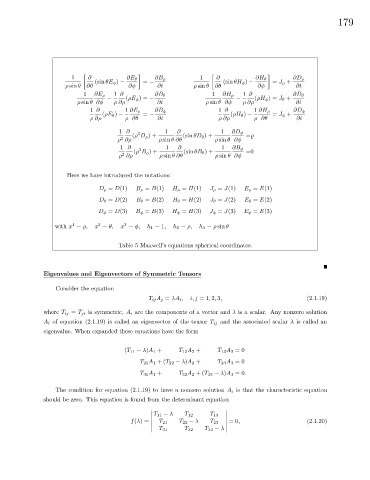
                       Here we have introduced the notations:
                                  D ρ = D(1)  B ρ = B(1)  H ρ = H(1)  J ρ = J(1)  E ρ = E(1)

                                  D θ = D(2)  B θ = B(2)  H θ = H(2)  J θ = J(2)  E θ = E(2)
                                  D φ = D(3)  B φ = B(3)  H φ = H(3)  J φ = J(3)  E φ = E(3)

                         1
                                          3
                                 2
                   with x = ρ,  x = θ,   x = φ,   h 1 =1,  h 2 = ρ,  h 3 = ρ sin θ
                                        Table 5 Maxwell’s equations spherical coordinates.


               Eigenvalues and Eigenvectors of Symmetric Tensors

                   Consider the equation
                                                  T ij A j = λA i ,  i, j =1, 2, 3,                   (2.1.19)

               where T ij = T ji is symmetric, A i are the components of a vector and λ is a scalar. Any nonzero solution
               A i of equation (2.1.19) is called an eigenvector of the tensor T ij and the associated scalar λ is called an
               eigenvalue. When expanded these equations have the form


                                          (T 11 − λ)A 1 +   T 12 A 2 +   T 13 A 3 =0
                                               T 21 A 1 +(T 22 − λ)A 2 +  T 23 A 3 =0
                                               T 31 A 1 +   T 32 A 2 +(T 33 − λ)A 3 =0.


                   The condition for equation (2.1.19) to have a nonzero solution A i is that the characteristic equation
               should be zero. This equation is found from the determinant equation


                                                      T 11 − λ  T 12  T 13

                                            f(λ)=     T 21  T 22 − λ  T 23     =0,                    (2.1.20)

                                                      T 31    T 32
                                                                     T 33 − λ

