


Page 185 - Intro to Tensor Calculus
P. 185
180


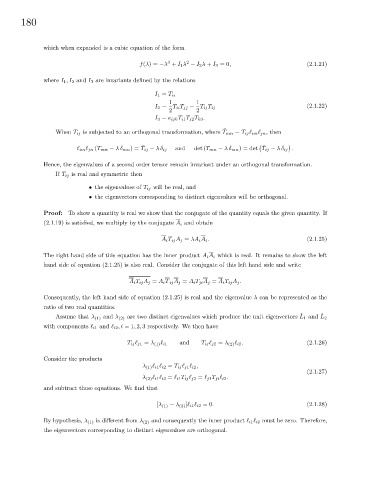
               which when expanded is a cubic equation of the form

                                                               2
                                                        3
                                               f(λ)= −λ + I 1 λ − I 2 λ + I 3 =0,                     (2.1.21)
               where I 1 ,I 2 and I 3 are invariants defined by the relations

                                                    I 1 = T ii
                                                         1        1
                                                    I 2 =  T ii T jj − T ij T ij                      (2.1.22)
                                                         2        2
                                                    I 3 = e ijk T i1 T j2 T k3 .
                                                                           ¯
                   When T ij is subjected to an orthogonal transformation, where T mn = T ij ` im ` jn ,then

                                                ¯                                       ¯
                          ` im ` jn (T mn − λδ mn )= T ij − λδ ij  and  det (T mn − λδ mn )= det T ij − λδ ij .

               Hence, the eigenvalues of a second order tensor remain invariant under an orthogonal transformation.
                   If T ij is real and symmetric then

                              • the eigenvalues of T ij will be real, and
                              • the eigenvectors corresponding to distinct eigenvalues will be orthogonal.


               Proof: To show a quantity is real we show that the conjugate of the quantity equals the given quantity. If
               (2.1.19) is satisfied, we multiply by the conjugate A i and obtain

                                                      A i T ij A j = λA i A i .                       (2.1.25)

               The right hand side of this equation has the inner product A i A i which is real. It remains to show the left
               hand side of equation (2.1.25) is also real. Consider the conjugate of this left hand side and write


                                            A i T ij A j = A i T ij A j = A i T ji A j = A i T ij A j .

               Consequently, the left hand side of equation (2.1.25) is real and the eigenvalue λ can be represented as the
               ratio of two real quantities.
                                                                                                    ˆ      ˆ
                   Assume that λ (1) and λ (2) are two distinct eigenvalues which produce the unit eigenvectors L 1 and L 2
               with components ` i1 and ` i2 ,i =1, 2, 3 respectively. We then have

                                           T ij ` j1 = λ (1) ` i1  and  T ij ` j2 = λ (2) ` i2 .      (2.1.26)


               Consider the products
                                                λ (1) ` i1 ` i2 = T ij ` j1 ` i2 ,
                                                                                                      (2.1.27)
                                                λ (2) ` i1 ` i2 = ` i1 T ij ` j2 = ` j1 T ji ` i2 .

               and subtract these equations. We find that

                                                     [λ (1) − λ (2) ]` i1 ` i2 =0.                    (2.1.28)

               By hypothesis, λ (1) is different from λ (2) and consequently the inner product ` i1 ` i2 must be zero. Therefore,
               the eigenvectors corresponding to distinct eigenvalues are orthogonal.

