


Page 135 - MATLAB an introduction with applications
P. 135
120 ———  MATLAB: An Introduction with Applications

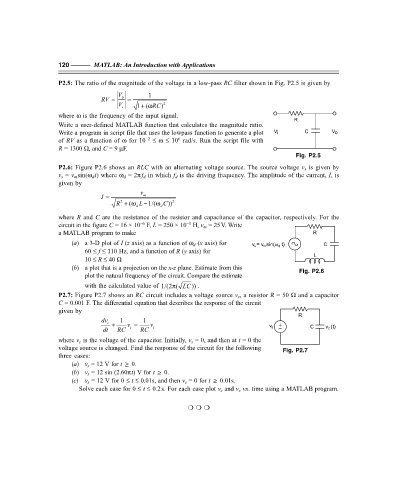
                   P2.5: The ratio of the magnitude of the voltage in a low-pass RC filter shown in Fig. P2.5 is given by

                                     V         1
                                RV =  0  =
                                     V i   1( RC+ω  ) 2
                   where ω is the frequency of the input signal.
                                                                                            R
                   Write a user-defined MATLAB function that calculates the magnitude ratio.
                   Write a program in script file that uses the lowpass function to generate a plot  V i  C  V o
                                                        6
                                              –2
                   of RV as a function of ω for 10  ≤ ω ≤ 10  rad/s. Run the script file with
                   R = 1300 Ω, and C = 9 µF.
                                                                                            Fig. P2.5
                   P2.6: Figure P2.6 shows an RLC with an alternating voltage source. The source voltage v s  is given by
                   v s  = v m sin(ω d t) where ω d  = 2πf d  in which f d  is the driving frequency. The amplitude of the current, I, is
                   given by
                                            v
                                I =          m
                                     R +ω  d L − 1/(ω d C )) 2
                                      2
                                         (
                   where R and C are the resistance of the resistor and capacitance of the capacitor, respectively. For the
                                                          –3
                   circuit in the figure C = 16 × 10  F, L = 250 × 10  H, v m  = 25V. Write
                                            –6
                   a MATLAB program to make                                                      R
                       (a) a 3-D plot of I (z axis) as a function of ω d  (x axis) for  v s = v sin(" d  t)  C
                                                                                  m
                           60 ≤ f ≤ 110 Hz, and a function of R (y axis) for
                           10 ≤ R ≤ 40 Ω                                                          L
                       (b) a plot that is a projection on the x-z plane. Estimate from this
                           plot the natural frequency of the circuit. Compare the estimate   Fig. P2.6
                           with the calculated value of 1/(2 ( LCπ  )) .
                   P2.7: Figure P2.7 shows an RC circuit includes a voltage source v s , a resistor R = 50 Ω and a capacitor
                   C = 0.001 F. The differential equation that describes the response of the circuit
                   given by
                                                                                             R
                                dv c  +  1  v =  1  v
                                 dt  RC  c  RC  s                                   v s         C    v c (t)
                   where v c  is the voltage of the capacitor. Initially, v s  = 0, and then at t = 0 the
                   voltage source is changed. Find the response of the circuit for the following  Fig. P2.7
                   three cases:
                       (a) v s  = 12 V for t  ≥  0.
                       (b) v s  = 12 sin (2.60πt) V for t  ≥  0.
                       (c) v s  = 12 V for 0 ≤ t ≤ 0.01s, and then v s  = 0 for t  ≥  0.01s.
                         Solve each case for 0 ≤ t ≤ 0.2s. For each case plot v s  and v c  vs. time using a MATLAB program.


                                                           ❍ ❍ ❍


                   F:\Final Book\Sanjay\IIIrd Printout\Dt. 10-03-09

