


Page 303 - A Practical Guide from Design Planning to Manufacturing
P. 303
Semiconductor Manufacturing  273


                                            Target

                                       E-field  Ar +  E-field


                   Wafer                    Wafer

                  Spin-on                  Sputtering

                 By-product

        Reactant 1       Reactant 2        Electrode
                                                        ±
                 Deposition                  Ions
                   Wafer                    Wafer

                   CVD                   Electroplating
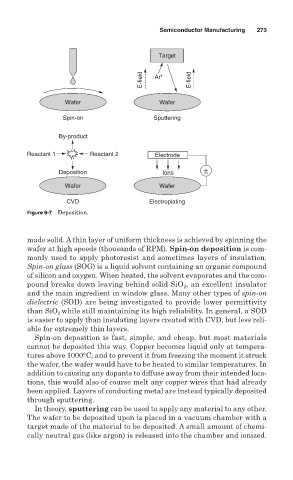
        Figure 9-7 Deposition.


        made solid. A thin layer of uniform thickness is achieved by spinning the
        wafer at high speeds (thousands of RPM). Spin-on deposition is com-
        monly used to apply photoresist and sometimes layers of insulation.
        Spin-on glass (SOG) is a liquid solvent containing an organic compound
        of silicon and oxygen. When heated, the solvent evaporates and the com-
        pound breaks down leaving behind solid SiO , an excellent insulator
                                                   2
        and the main ingredient in window glass. Many other types of spin-on
        dielectric (SOD) are being investigated to provide lower permittivity
                  while still maintaining its high reliability. In general, a SOD
        than SiO 2
        is easier to apply than insulating layers created with CVD, but less reli-
        able for extremely thin layers.
          Spin-on deposition is fast, simple, and cheap, but most materials
        cannot be deposited this way. Copper becomes liquid only at tempera-
        tures above 1000°C, and to prevent it from freezing the moment it struck
        the wafer, the wafer would have to be heated to similar temperatures. In
        addition to causing any dopants to diffuse away from their intended loca-
        tions, this would also of course melt any copper wires that had already
        been applied. Layers of conducting metal are instead typically deposited
        through sputtering.
          In theory, sputtering can be used to apply any material to any other.
        The wafer to be deposited upon is placed in a vacuum chamber with a
        target made of the material to be deposited. A small amount of chemi-
        cally neutral gas (like argon) is released into the chamber and ionized.

