


Page 170 - Semiconductor Manufacturing Handbook
P. 170
Geng(SMH)_CH12.qxd  04/04/2005  19:49  Page 12.19


                                                         PLASMA ETCHING

                                                                                       PLASMA ETCHING  12.19


                                                  RF bias power (ion energy)


                                                             ICP power (plasma density)
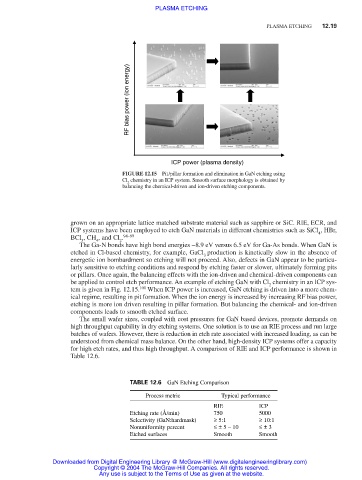
                                                FIGURE 12.15 Pit/pillar formation and elimination in GaN etching using
                                                Cl chemistry in an ICP system. Smooth surface morphology is obtained by
                                                 2
                                                balancing the chemical-driven and ion-driven etching components.


                                  grown on an appropriate lattice matched substrate material such as sapphire or SiC. RIE, ECR, and
                                  ICP systems have been employed to etch GaN materials in different chemistries such as SiCl , HBr,
                                                                                                     4
                                  BCl , CH , and Cl . 94–99
                                     3   4     2
                                    The Ga-N bonds have high bond energies −8.9 eV versus 6.5 eV for Ga-As bonds. When GaN is
                                  etched in Cl-based chemistry, for example, GaCl production is kinetically slow in the absence of
                                                                      3
                                  energetic ion bombardment so etching will not proceed. Also, defects in GaN appear to be particu-
                                  larly sensitive to etching conditions and respond by etching faster or slower, ultimately forming pits
                                  or pillars. Once again, the balancing effects with the ion-driven and chemical-driven components can
                                  be applied to control etch performance. An example of etching GaN with Cl chemistry in an ICP sys-
                                                                                        2
                                  tem is given in Fig. 12.15. 100  When ICP power is increased, GaN etching is driven into a more chem-
                                  ical regime, resulting in pit formation. When the ion energy is increased by increasing RF bias power,
                                  etching is more ion driven resulting in pillar formation. But balancing the chemical- and ion-driven
                                  components leads to smooth etched surface.
                                    The small wafer sizes, coupled with cost pressures for GaN based devices, promote demands on
                                  high throughput capability in dry etching systems. One solution is to use an RIE process and run large
                                  batches of wafers. However, there is reduction in etch rate associated with increased loading, as can be
                                  understood from chemical mass balance. On the other hand, high-density ICP systems offer a capacity
                                  for high etch rates, and thus high throughput. A comparison of RIE and ICP performance is shown in
                                  Table 12.6.


                                                  TABLE 12.6 GaN Etching Comparison

                                                      Process metric       Typical performance
                                                                         RIE         ICP
                                                  Etching rate (Å/min)   750         5000
                                                  Selectivity (GaN:hardmask)  ≥ 5:1  ≥ 10:1
                                                  Nonuniformity percent  ≤± 5 – 10   ≤± 3
                                                  Etched surfaces        Smooth      Smooth


                             Downloaded from Digital Engineering Library @ McGraw-Hill (www.digitalengineeringlibrary.com)
                                        Copyright © 2004 The McGraw-Hill Companies. All rights reserved.
                                          Any use is subject to the Terms of Use as given at the website.

