


Page 180 - Semiconductor Manufacturing Handbook
P. 180
Geng(SMH)_CH13.qxd  04/04/2005  19:50  Page 13.3


                                                    PHYSICAL VAPOR DEPOSITION

                                                                                PHYSICAL VAPOR DEPOSITION  13.3


                                           100                                                0 20
                                       Percentage of vapor particles passing the distance r without collision  %  60  r  40  %  collisions while passing the distance r  Percentage of vapor particles experiencing
                                            80


                                                                                              60
                                            40

                                            20

                                                                                              100
                                             0                                                80
                                              100 50         10  5          1  0.5        0.1
                                                                     −
                                                                     l
                                                                       r
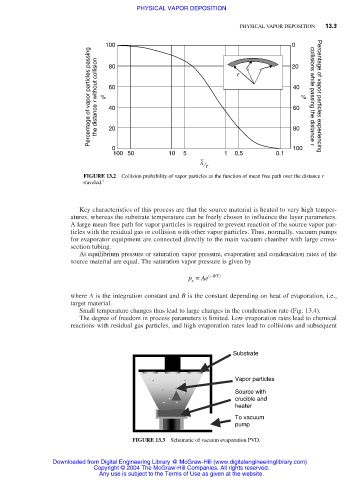
                                      FIGURE 13.2 Collision probability of vapor particles as the function of mean free path over the distance r
                                      traveled. 1

                                    Key characteristics of this process are that the source material is heated to very high temper-
                                  atures, whereas the substrate temperature can be freely chosen to influence the layer parameters.
                                  A large mean free path for vapor particles is required to prevent reaction of the source vapor par-
                                  ticles with the residual gas or collision with other vapor particles. Thus, normally, vacuum pumps
                                  for evaporator equipment are connected directly to the main vacuum chamber with large cross-
                                  section tubing.
                                    At equilibrium pressure or saturation vapor pressure, evaporation and condensation rates of the
                                  source material are equal. The saturation vapor pressure is given by
                                                                  p =  Ae  − (  BT / )
                                                                   s

                                  where A is the integration constant and B is the constant depending on heat of evaporation, i.e.,
                                  target material.
                                    Small temperature changes thus lead to large changes in the condensation rate (Fig. 13.4).
                                    The degree of freedom in process parameters is limited. Low evaporation rates lead to chemical
                                  reactions with residual gas particles, and high evaporation rates lead to collisions and subsequent


                                                                              Substrate


                                                                               Vapor particles
                                                                               Source with
                                                                               crucible and
                                                                               heater
                                                                               To vacuum
                                                                               pump
                                                   FIGURE 13.3  Schematic of vacuum evaporation PVD.


                             Downloaded from Digital Engineering Library @ McGraw-Hill (www.digitalengineeringlibrary.com)
                                        Copyright © 2004 The McGraw-Hill Companies. All rights reserved.
                                          Any use is subject to the Terms of Use as given at the website.

