


Page 185 - Semiconductor Manufacturing Handbook
P. 185
Geng(SMH)_CH13.qxd  04/04/2005  19:51  Page 13.8


                                                 PHYSICAL VAPOR DEPOSITION

                   13.8  WAFER PROCESSING


                                                                                              dA r
                                                    θ
                                                                                          θ
                                          dA r    90°


                                                      dω
                                           ϕ    r                                  ϕ
                                                                                r 0


                                        dA e                                   dA e

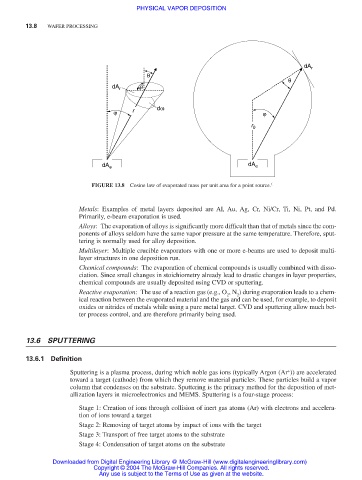
                                     FIGURE 13.8  Cosine law of evaporated mass per unit area for a point source. 1


                                 Metals: Examples of metal layers deposited are  Al,  Au,  Ag, Cr, Ni/Cr,  Ti, Ni, Pt, and Pd.
                                 Primarily, e-beam evaporation is used.
                                 Alloys: The evaporation of alloys is significantly more difficult than that of metals since the com-
                                 ponents of alloys seldom have the same vapor pressure at the same temperature. Therefore, sput-
                                 tering is normally used for alloy deposition.
                                 Multilayer: Multiple crucible evaporators with one or more e-beams are used to deposit multi-
                                 layer structures in one deposition run.
                                 Chemical compounds: The evaporation of chemical compounds is usually combined with disso-
                                 ciation. Since small changes in stoichiometry already lead to drastic changes in layer properties,
                                 chemical compounds are usually deposited using CVD or sputtering.
                                 Reactive evaporation: The use of a reaction gas (e.g., O , N ) during evaporation leads to a chem-
                                                                         2
                                                                            2
                                 ical reaction between the evaporated material and the gas and can be used, for example, to deposit
                                 oxides or nitrides of metals while using a pure metal target. CVD and sputtering allow much bet-
                                 ter process control, and are therefore primarily being used.

                   13.6 SPUTTERING

                   13.6.1 Definition

                                                                                          +
                               Sputtering is a plasma process, during which noble gas ions (typically Argon (Ar )) are accelerated
                               toward a target (cathode) from which they remove material particles. These particles build a vapor
                               column that condenses on the substrate. Sputtering is the primary method for the deposition of met-
                               allization layers in microelectronics and MEMS. Sputtering is a four-stage process:
                                 Stage 1: Creation of ions through collision of inert gas atoms (Ar) with electrons and accelera-
                                 tion of ions toward a target
                                 Stage 2: Removing of target atoms by impact of ions with the target
                                 Stage 3: Transport of free target atoms to the substrate
                                 Stage 4: Condensation of target atoms on the substrate

                          Downloaded from Digital Engineering Library @ McGraw-Hill (www.digitalengineeringlibrary.com)
                                     Copyright © 2004 The McGraw-Hill Companies. All rights reserved.
                                       Any use is subject to the Terms of Use as given at the website.

