


Page 189 - Semiconductor Manufacturing Handbook
P. 189
Geng(SMH)_CH13.qxd  04/04/2005  19:51  Page 13.12


                                                 PHYSICAL VAPOR DEPOSITION

                   13.12  WAFER PROCESSING

                               characterization are x-ray diffraction (XRD), electron dispersive x-ray spectroscopy/wavelength
                               dispersive x-ray spectroscopy (EDX/WDX), Auger electron spectroscopy (AES), scanning electron
                               microscope (SEM), and transmission electron microscope (TEM). XRD is used to determine the
                               crystallinity and texture of the layers. A broader peak signifies smaller grain size. EDX/WDX is used
                               to determine the composition of the layers, to detect contamination, stoichiometry of compound layers
                               and reaction of donors, and dopant materials with underlying base layers.

                                 Zones 1–3 as in evaporation
                                 Zone T—fiber-type closely packed layer with smooth surface


                   13.7 SPUTTER EQUIPMENT

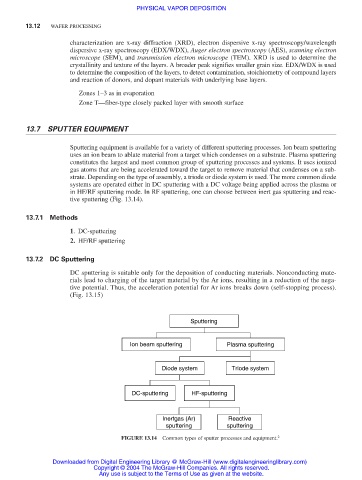
                               Sputtering equipment is available for a variety of different sputtering processes. Ion beam sputtering
                               uses an ion beam to ablate material from a target which condenses on a substrate. Plasma sputtering
                               constitutes the largest and most common group of sputtering processes and systems. It uses ionized
                               gas atoms that are being accelerated toward the target to remove material that condenses on a sub-
                               strate. Depending on the type of assembly, a triode or diode system is used. The more common diode
                               systems are operated either in DC sputtering with a DC voltage being applied across the plasma or
                               in HF/RF sputtering mode. In RF sputtering, one can choose between inert gas sputtering and reac-
                               tive sputtering (Fig. 13.14).

                   13.7.1 Methods
                               1. DC-sputtering
                               2. HF/RF sputtering


                   13.7.2 DC Sputtering
                               DC sputtering is suitable only for the deposition of conducting materials. Nonconducting mate-
                               rials lead to charging of the target material by the Ar ions, resulting in a reduction of the nega-
                               tive potential. Thus, the acceleration potential for Ar ions breaks down (self-stopping process).
                               (Fig. 13.15)


                                                                Sputtering


                                               Ion beam sputtering       Plasma sputtering


                                                        Diode system       Triode system


                                                DC-sputtering   HF-sputtering


                                                        Inertgas (Ar)     Reactive
                                                         sputtering      sputtering
                                             FIGURE 13.14  Common types of sputter processes and equipment. 2


                          Downloaded from Digital Engineering Library @ McGraw-Hill (www.digitalengineeringlibrary.com)
                                     Copyright © 2004 The McGraw-Hill Companies. All rights reserved.
                                       Any use is subject to the Terms of Use as given at the website.

