


Page 194 - Semiconductor Manufacturing Handbook
P. 194
Geng(SMH)_CH13.qxd  05/04/2005  18:03  Page 13.17


                                                    PHYSICAL VAPOR DEPOSITION

                                                                               PHYSICAL VAPOR DEPOSITION  13.17

                                  of the main chamber, since venting of the main chamber is not
                                  required for substrate loading. The vacuum system is usually a
                                  two-stage system with a mechanical coarse vacuum pump and a
                                  turbo high vacuum pump. Ion current gauges are used to deter-
                                  mine the process chamber pressure at high vacuum. A residual  -  -
                                  gas analyzer is used to determine the concentration and compo-  -  -
                                  sition of the residual gas.                            -       -
                                                                                               -
                                  Cooling Water.  For chamber temperature control, a cooling  N  -
                                  water system (dual-walled chamber or welded steel tubing) and  S
                                  a radiation heater is used. A good chamber design eliminates the  N
                                  possibility of cooling water entering the chamber and getting in
                                  contact with electronics and current-carrying  or  high-voltage
                                  parts in case of a leakage or system breakdown.
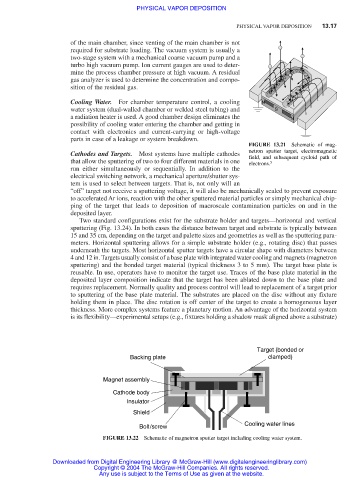
                                                                                  FIGURE 13.21  Schematic of mag-
                                                                                  netron sputter target, electromagnetic
                                  Cathodes and Targets.  Most systems have multiple cathodes
                                                                                  field, and subsequent cycloid path of
                                  that allow the sputtering of two to four different materials in one
                                                                                  electrons. 5
                                  run either simultaneously or sequentially. In addition to the
                                  electrical switching network, a mechanical aperture/shutter sys-
                                  tem is used to select between targets. That is, not only will an
                                  “off” target not receive a sputtering voltage, it will also be mechanically sealed to prevent exposure
                                  to accelerated Ar ions, reaction with the other sputtered material particles or simply mechanical chip-
                                  ping of the target that leads to deposition of macroscale contamination particles on and in the
                                  deposited layer.
                                    Two standard configurations exist for the substrate holder and targets—horizontal and vertical
                                  sputtering (Fig. 13.24). In both cases the distance between target and substrate is typically between
                                  15 and 35 cm, depending on the target and palette sizes and geometries as well as the sputtering para-
                                  meters. Horizontal sputtering allows for a simple substrate holder (e.g., rotating disc) that passes
                                  underneath the targets. Most horizontal sputter targets have a circular shape with diameters between
                                  4 and 12 in. Targets usually consist of a base plate with integrated water cooling and magnets (magnetron
                                  sputtering) and the bonded target material (typical thickness 3 to 5 mm). The target base plate is
                                  reusable. In use, operators have to monitor the target use. Traces of the base plate material in the
                                  deposited layer composition indicate that the target has been ablated down to the base plate and
                                  requires replacement. Normally quality and process control will lead to replacement of a target prior
                                  to sputtering of the base plate material. The substrates are placed on the disc without any fixture
                                  holding them in place. The disc rotation is off center of the target to create a homogeneous layer
                                  thickness. More complex systems feature a planetary motion. An advantage of the horizontal system
                                  is its flexibility—experimental setups (e.g., fixtures holding a shadow mask aligned above a substrate)


                                                                                    Target (bonded or
                                                  Backing plate                        clamped)


                                           Magnet assembly
                                              Cathode body
                                                 Insulator
                                                   Shield
                                                                                 Cooling water lines
                                                     Bolt/screw
                                           FIGURE 13.22  Schematic of magnetron sputter target including cooling water system.


                             Downloaded from Digital Engineering Library @ McGraw-Hill (www.digitalengineeringlibrary.com)
                                        Copyright © 2004 The McGraw-Hill Companies. All rights reserved.
                                          Any use is subject to the Terms of Use as given at the website.

