


Page 196 - Semiconductor Manufacturing Handbook
P. 196
Geng(SMH)_CH13.qxd  04/04/2005  19:51  Page 13.19


                                                    PHYSICAL VAPOR DEPOSITION

                                                                               PHYSICAL VAPOR DEPOSITION  13.19

                      13.8 LAYERS DEPOSITED USING SPUTTERING

                                  As previously mentioned, sputtering allows the deposition of almost any kind of material. It allows
                                  the deposition of a free choice of metals, including those with high melting temperature. Depending
                                  on the target size and material, target prices can vary a lot (e.g., Al1Si target 10 in × 5 mm: $1,000;
                                  Pt target 10 in × 5 mm: $18,000). All alloys can be deposited using sputtering, depending on the
                                  availability of targets for the specific sputtering system. Multilayer structures can be deposited using
                                  multiple target sputter equipment with apertures to prevent cross contamination of targets. Chemical
                                  compounds (dielectric materials, insulators, metal oxides) can be deposited either using specific
                                  compound targets (mostly sintered material) and/or using reactive sputtering. A typical configuration
                                  is using a metal or semiconductor material target and a reactive ambient gas atmosphere (O , N ) to
                                                                                                    2  2
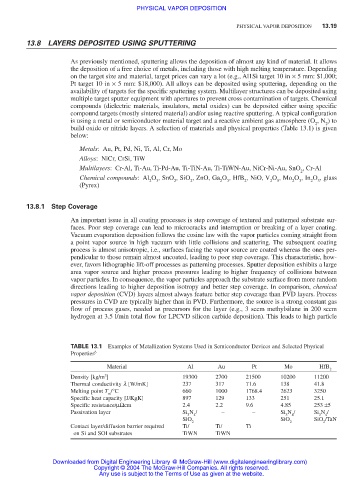
                                  build oxide or nitride layers. A selection of materials and physical properties (Table 13.1) is given
                                  below:
                                    Metals: Au, Pt, Pd, Ni, Ti, Al, Cr, Mo
                                    Alloys: NiCr, CrSi, TiW
                                    Multilayers: Cr-Al, Ti-Au, Ti-Pd-Au, Ti-TiN-Au, Ti-TiWN-Au, NiCr-Ni-Au, SnO , Cr-Al
                                                                                                2
                                    Chemical compounds:Al O , SnO , SiO , ZnO, Ga O , HfB , NiO, V O , Mo O , In O , glass
                                                       2  3   2   2       2  3   2      2  5  2  3  2  3
                                    (Pyrex)

                      13.8.1 Step Coverage
                                  An important issue in all coating processes is step coverage of textured and patterned substrate sur-
                                  faces. Poor step coverage can lead to microcracks and interruption or breaking of a layer coating.
                                  Vacuum evaporation deposition follows the cosine law with the vapor particles coming straight from
                                  a point vapor source in high vacuum with little collisions and scattering. The subsequent coating
                                  process is almost anisotropic, i.e., surfaces facing the vapor source are coated whereas the ones per-
                                  pendicular to those remain almost uncoated, leading to poor step coverage. This characteristic, how-
                                  ever, favors lithographic lift-off processes as patterning processes. Sputter deposition exhibits a large
                                  area vapor source and higher process pressures leading to higher frequency of collisions between
                                  vapor particles. In consequence, the vapor particles approach the substrate surface from more random
                                  directions leading to higher deposition isotropy and better step coverage. In comparison, chemical
                                  vapor deposition (CVD) layers almost always feature better step coverage than PVD layers. Process
                                  pressures in CVD are typically higher than in PVD. Furthermore, the source is a strong constant gas
                                  flow of process gases, needed as precursors for the layer (e.g., 3 sccm methylsilane in 200 sccm
                                  hydrogen at 3.5 l/min total flow for LPCVD silicon carbide deposition). This leads to high particle


                                  TABLE 13.1 Examples of Metallization Systems Used in Semiconductor Devices and Selected Physical
                                  Properties 6
                                            Material              Al      Au       Pt       Mo       HfB
                                                                                                        2
                                           3
                                  Density [kg/m ]               19300    2700    21500     10200    11200
                                  Thermal conductivity l [W/mK]  237     317     71.6      138      41.8
                                  Melting point T /°C           660      1000    1768.4    2623     3250
                                            m
                                  Specific heat capacity [J/KgK]  897    129     133       251      25.1
                                  Specific resistance/µΩcm      2.4      2.2     9.6       4.85     253 ±5
                                  Passivation layer             Si N /     –       –       Si N /   Si N /
                                                                  3  4                      3  4     3  4
                                                                SiO                        SiO      SiO /TaN
                                                                   2                         2        2
                                  Contact layer/diffusion barrier required  Ti/  Ti/  Ti
                                   on Si and SOI substrates     TiWN     TiWN
                             Downloaded from Digital Engineering Library @ McGraw-Hill (www.digitalengineeringlibrary.com)
                                        Copyright © 2004 The McGraw-Hill Companies. All rights reserved.
                                          Any use is subject to the Terms of Use as given at the website.

