


Page 201 - Semiconductor Manufacturing Handbook
P. 201
Geng(SMH)_CH14.qxd  04/04/2005  19:52  Page 14.2


                                                 CHEMICAL VAPOR DEPOSITION

                   14.2  WAFER PROCESSING


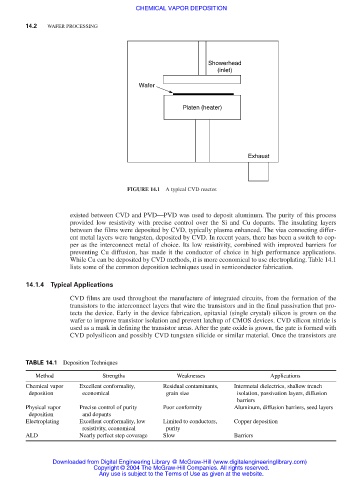
                                                                    Showerhead
                                                                       (inlet)
                                                  Wafer


                                                             Platen (heater)


                                                                               Exhaust


                                              FIGURE 14.1  A typical CVD reactor.


                               existed between CVD and PVD—PVD was used to deposit aluminum. The purity of this process
                               provided low resistivity with precise control over the Si and Cu dopants.  The insulating layers
                               between the films were deposited by CVD, typically plasma enhanced. The vias connecting differ-
                               ent metal layers were tungsten, deposited by CVD. In recent years, there has been a switch to cop-
                               per as the interconnect metal of choice. Its low resistivity, combined with improved barriers for
                               preventing Cu diffusion, has made it the conductor of choice in high performance applications.
                               While Cu can be deposited by CVD methods, it is more economical to use electroplating. Table 14.1
                               lists some of the common deposition techniques used in semiconductor fabrication.

                   14.1.4 Typical Applications
                               CVD films are used throughout the manufacture of integrated circuits, from the formation of the
                               transistors to the interconnect layers that wire the transistors and in the final passivation that pro-
                               tects the device. Early in the device fabrication, epitaxial (single crystal) silicon is grown on the
                               wafer to improve transistor isolation and prevent latchup of CMOS devices. CVD silicon nitride is
                               used as a mask in defining the transistor areas. After the gate oxide is grown, the gate is formed with
                               CVD polysilicon and possibly CVD tungsten silicide or similar material. Once the transistors are


                   TABLE 14.1 Deposition Techniques
                      Method            Strengths           Weaknesses               Applications
                   Chemical vapor   Excellent conformality,   Residual contaminants,   Intermetal dielectrics, shallow trench
                    deposition    economical             grain size         isolation, passivation layers, diffusion
                                                                            barriers
                   Physical vapor   Precise control of purity   Poor conformity  Aluminum, diffusion barriers, seed layers
                    deposition    and dopants
                   Electroplating  Excellent conformality, low   Limited to conductors,   Copper deposition
                                  resistivity, economical  purity
                   ALD            Nearly perfect step coverage  Slow       Barriers


                          Downloaded from Digital Engineering Library @ McGraw-Hill (www.digitalengineeringlibrary.com)
                                     Copyright © 2004 The McGraw-Hill Companies. All rights reserved.
                                       Any use is subject to the Terms of Use as given at the website.

