


Page 197 - Semiconductor Manufacturing Handbook
P. 197
Geng(SMH)_CH13.qxd  04/04/2005  19:51  Page 13.20


                                                 PHYSICAL VAPOR DEPOSITION

                   13.20  WAFER PROCESSING

                                           Vacuum evaporation      Sputtering          CVD


                                    Direction of
                                   vapor particles
                                          Coating layer       Coating layer       Coating layer
                                          Patterned            Patterned           Patterned
                                         layer, e.g., SiO 2  Coating layer  layer, e.g., SiO 2  Coating layer  layer, e.g., SiO 2  Coating layer
                                               Substrate,           Substrate,         Substrate,
                                               e.g., silicon       e.g., silicon       e.g., silicon

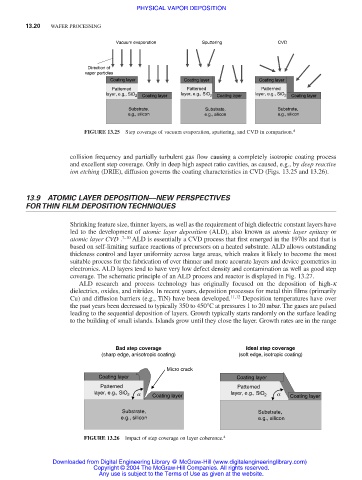
                                   FIGURE 13.25  Step coverage of vacuum evaporation, sputtering, and CVD in comparison.  4


                               collision frequency and partially turbulent gas flow causing a completely isotropic coating process
                               and excellent step coverage. Only in deep high aspect ratio cavities, as caused, e.g., by deep reactive
                               ion etching (DRIE), diffusion governs the coating characteristics in CVD (Figs. 13.25 and 13.26).


                   13.9 ATOMIC LAYER DEPOSITION––NEW PERSPECTIVES
                   FOR THIN FILM DEPOSITION TECHNIQUES

                               Shrinking feature size, thinner layers, as well as the requirement of high dielectric constant layers have
                               led to the development of atomic layer deposition (ALD), also known as atomic layer epitaxy or
                               atomic layer CVD . 7–10  ALD is essentially a CVD process that first emerged in the 1970s and that is
                               based on self-limiting surface reactions of precursors on a heated substrate. ALD allows outstanding
                               thickness control and layer uniformity across large areas, which makes it likely to become the most
                               suitable process for the fabrication of ever thinner and more accurate layers and device geometries in
                               electronics. ALD layers tend to have very low defect density and contamination as well as good step
                               coverage. The schematic principle of an ALD process and reactor is displayed in Fig. 13.27.
                                 ALD research and process technology has originally focused on the deposition of high-k
                               dielectrics, oxides, and nitrides. In recent years, deposition processes for metal thin films (primarily
                               Cu) and diffusion barriers (e.g., TiN) have been developed. 11,12  Deposition temperatures have over
                               the past years been decreased to typically 350 to 450°C at pressures 1 to 20 mbar. The gases are pulsed
                               leading to the sequential deposition of layers. Growth typically starts randomly on the surface leading
                               to the building of small islands. Islands grow until they close the layer. Growth rates are in the range


                                           Bad step coverage                   Ideal step coverage
                                       (sharp edge, anisotropic coating)     (soft edge, isotropic coating)
                                                         Micro crack
                                       Coating layer                        Coating layer
                                       Patterned                            Patterned
                                     layer, e.g., SiO 2  a  Coating layer  layer, e.g., SiO 2  a  Coating layer
                                             Substrate,                           Substrate,
                                             e.g., silicon                        e.g., silicon


                                   FIGURE 13.26  Impact of step coverage on layer coherence. 4


                          Downloaded from Digital Engineering Library @ McGraw-Hill (www.digitalengineeringlibrary.com)
                                     Copyright © 2004 The McGraw-Hill Companies. All rights reserved.
                                       Any use is subject to the Terms of Use as given at the website.

